🦷 Why Fluid Builds Up: Portal Hypertension, Ascites, and the Hidden Physics of Liver Disease

How pressure, proteins, inflammation, and circulation turn liver damage into visible swelling

🧠 Big Picture: Fluid Does Not “Randomly Leak”
When fluid builds up in the abdomen, the real question is not simply:
“Why is there fluid?”
The better clinical question is:
What forces are pushing fluid out of the bloodstream, and why can’t the body pull it back in?
Ascites is not random swelling. It is the visible result of a deeper system problem involving:
pressure inside blood vessels
protein levels, especially albumin
liver structure and resistance
kidney compensation
infection risk

1. The Normal Model: How Fluid Usually Stays Balanced
Your blood vessels are not sealed pipes. Fluid constantly moves between:
blood vessels
tissues
lymphatics
The body keeps that movement balanced through two major forces:
Force | What It Does | Simple Meaning |
Hydrostatic pressure | Pushes fluid out of vessels | “Push force” |
Oncotic pressure | Pulls fluid back into vessels | “Protein pull” |
The most important protein for oncotic pressure is albumin, which is made by the liver.
ToothOps mental model
Fluid balance = push vs pull.
Portal hypertension increases the push.
Low albumin weakens the pull.

2. What Is Portal Hypertension?
The portal vein carries blood from the intestines and spleen into the liver.
Normally:
GI tract → portal vein → liver → systemic circulation
But when the liver becomes scarred, inflamed, or structurally distorted, blood cannot pass through easily.
That increased resistance creates:
portal hypertension = high pressure in the portal venous system
Mechanism
Liver injury causes fibrosis or architectural distortion
Blood flow through liver becomes restricted
Pressure backs up into portal circulation
Fluid is pushed out of vessels
Ascites begins to form
Analogy
Think of the liver like a filter in a plumbing system.
If the filter becomes clogged:
pressure builds behind it
fluid backs up
nearby vessels become overloaded

3. Why Ascites Forms: The Multi-System Cascade
Ascites is fluid accumulation in the peritoneal cavity. It is not caused by one mechanism alone.
It forms because multiple systems fail at once.
A. Increased hydrostatic pressure
Portal hypertension increases pressure in abdominal vessels.
That pressure pushes fluid out into the abdominal cavity.
If you only remember one thing
High portal pressure forces fluid outward.
B. Decreased oncotic pressure
The damaged liver may produce less albumin.
Less albumin means less protein pull holding fluid inside the bloodstream.
If you only remember one thing
Low albumin means fluid is harder to keep inside vessels.
C. Kidney compensation makes it worse
When fluid leaves the circulation, the body may sense “low effective blood volume.”
The kidneys respond by retaining:
sodium
water
This is meant to protect circulation, but in ascites it can worsen fluid accumulation.
ToothOps insight
The body tries to compensate, but the compensation can amplify the problem.
D. Inflammation changes vascular permeability
Inflammation can make vessels more permeable, allowing fluid and proteins to move more easily into tissues and body cavities.
This connects ascites to the broader inflammation system you’ve already built in ToothOps.

4. Ascites Formation Table
Mechanism | What Happens | Clinical Result |
Portal hypertension | Pressure rises upstream of liver | Fluid pushed outward |
Low albumin | Less oncotic pull | Fluid stays outside vessels |
Kidney sodium retention | Water follows sodium | More fluid accumulation |
Inflammation | Vessel permeability increases | Fluid moves more easily |
Lymphatic overload | Drainage cannot keep up | Persistent ascites |
5. Why Ascitic Fluid Can Become Dangerous
A major misconception is:
“Ascites is just extra fluid.”
But ascitic fluid can become a biological environment where infection develops.
The study guide directly includes blood and ascites cultures and secondary bacterial peritonitis, which means the fluid is clinically important—not just visually noticeable.
Mechanism of infection risk
Fluid accumulates in the abdomen
Immune surveillance may be reduced
Gut bacteria may translocate
Bacteria enter ascitic fluid
Peritonitis can develop
ToothOps insight
Fluid is not passive.Once it accumulates, it can become an infection space.
6. Clinical Pattern Recognition
Finding | What It Suggests |
Abdominal swelling | Ascites |
Jaundice | Bilirubin handling problem |
Easy bleeding/bruising | Liver-related clotting issue possible |
Fever + abdominal pain | Infection concern |
Elevated ALT | Liver cell injury |
Elevated AFP | Possible liver malignancy marker |
The case guide includes jaundice, ALT, alpha-fetoprotein, liver biopsy, and cultures as part of the diagnostic framework.
7. Why This Matters in Dentistry
A patient with advanced liver disease or portal hypertension may have more than a “liver problem.”
They may also have:
altered clotting factor production
thrombocytopenia from splenic sequestration
impaired healing
increased bleeding risk
increased infection vulnerability
This matters before:
extractions
periodontal surgery
implant planning
deep scaling
management of oral trauma
Dental clinical reasoning
Do not only ask:
“Does this patient have ascites?”
Ask:
What does ascites tell me about liver function, bleeding risk, infection risk, and healing capacity?

8. Chairside Explanation
“Fluid buildup can happen when liver disease changes blood pressure, protein balance, and circulation. Because the liver also affects clotting and healing, we may need to plan dental treatment more carefully and coordinate with your medical team when needed.”
9. Clinical Reasoning Framework
When you see ascites or liver disease history, think:
Question | Why It Matters |
Is there portal hypertension? | Explains pressure-driven fluid shift |
Is albumin low? | Explains poor fluid retention in vessels |
Is there jaundice? | Suggests impaired bilirubin handling |
Are platelets low? | May increase bleeding risk |
Are PT/INR abnormal? | May suggest impaired clotting factor production |
Is there fever or abdominal pain? | Raises infection concern |
Is dental surgery planned? | Requires bleeding/healing risk assessment |
10. Common Misconceptions
Misconception | Better Understanding |
“Ascites is just swelling.” | It reflects systemic fluid imbalance. |
“Fluid means drinking too much water.” | It usually involves pressure, protein, and organ dysfunction. |
“Liver disease only affects digestion.” | It affects clotting, immunity, metabolism, and circulation. |
“No pain means no danger.” | Ascites can be clinically serious even before severe symptoms appear. |
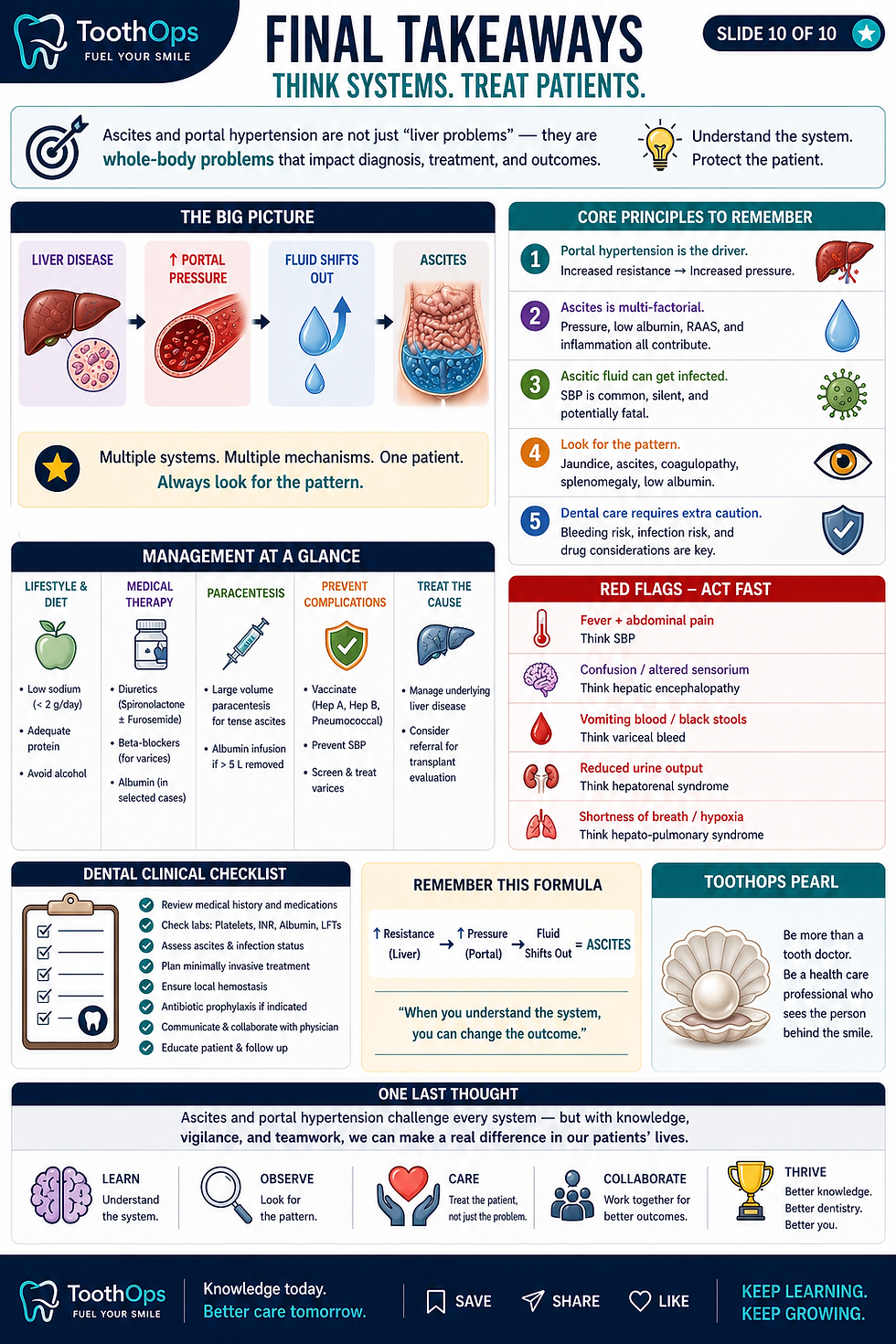
🧠 ToothOps Insight
Ascites is not just fluid.
It is a visible sign that the body’s pressure system, protein system, liver system, kidney system, and immune system are no longer balanced.
✨ Final Takeaway
Fluid buildup follows rules.
When you understand portal hypertension and ascites, you stop seeing swelling as a vague symptom and start seeing it as a map of systemic dysfunction.
@ToothOps | Fuel Your Smile 😊
Stay tuned for more insights and educational content in our blog.
Disclaimer: Content is for educational purposes only and not a substitute for medical or dental care.
© 2025 ToothOps | All Rights Reserved.


Comments