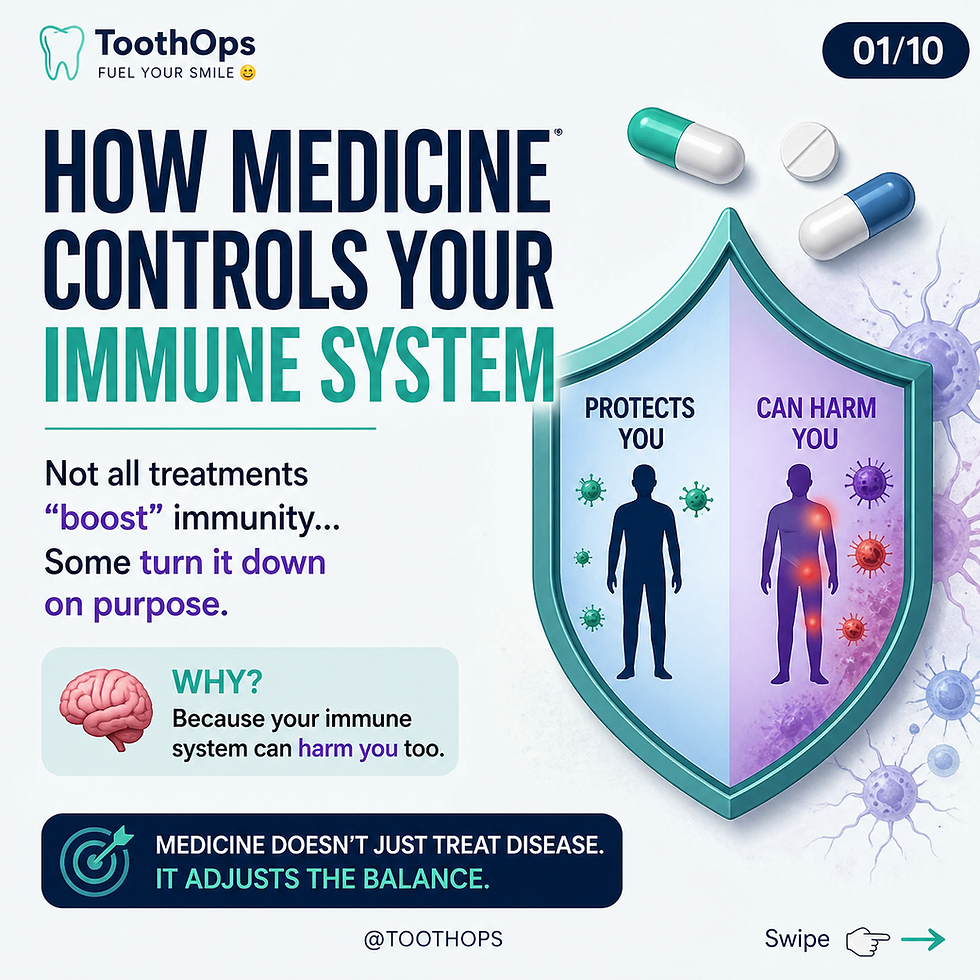
🦷 How Medicine Controls the Immune System — Corticosteroids, Immunosuppressants, and the Biological Trade-Off of Healing

🧠 The Real Question
When we treat disease, we often assume:
👉 “The goal is to strengthen the immune system.”
But in many conditions, the real goal is the opposite:
👉 To deliberately suppress the immune system
🧠 Core Insight
Many diseases are not caused by weak immunitybut by overactive or misdirected immune responses
And:
Many treatments work not by “fighting disease”but by controlling the body’s own response
⚙️ PART 1 — WHEN THE IMMUNE SYSTEM BECOMES THE PROBLEM
From your study guide:
👉 Hypersensitivity = exaggerated immune response causing tissue damage
🔬 Mechanism Overview
Type I (Immediate — IgE mediated)
allergen binds IgE on mast cells→ degranulation→ histamine release
👉 leads to:
vasodilation
capillary leakage
bronchoconstriction
Type II (Antibody-mediated destruction)
IgG / IgM attack host cells
Type III (Immune complex deposition)
antigen-antibody complexes deposit in tissues→ inflammation
Type IV (Delayed, T-cell mediated)
cytokine-driven inflammation (24–72 hours delay)
🧠 Clinical Insight
The same immune system that protects youcan destroy your own tissues depending on the mechanism

⚙️ PART 2 — WHY MEDICINE SUPPRESSES THE IMMUNE SYSTEM
🧠 The Biological Trade-Off
Goal | Consequence |
Reduce inflammation | ↓ tissue damage |
Suppress immune response | ↑ infection risk |
🧠 ToothOps Insight
Treatment is always a balance between:
👉 controlling damage
👉 preserving defense
⚙️ PART 3 — CORTICOSTEROIDS (PREDNISONE)
🔬 Mechanism (Graduate-Level)
Corticosteroids act at the gene expression level:
↓ cytokine production
↓ leukocyte migration
↓ prostaglandins & leukotrienes
↓ vascular permeability
🧠 Translation
They shut down the inflammatory cascade early
⚠️ Clinical Effects
Effect | Outcome |
↓ inflammation | symptom relief |
↓ immune response | infection risk |
↓ fibroblast activity | delayed healing |
🦷 Dental Relevance
slower wound healing
increased infection risk
altered inflammatory signs
💬 Chairside Script
“This medication helps control inflammation, but it can also slow healing slightly, so we’ll monitor closely.”

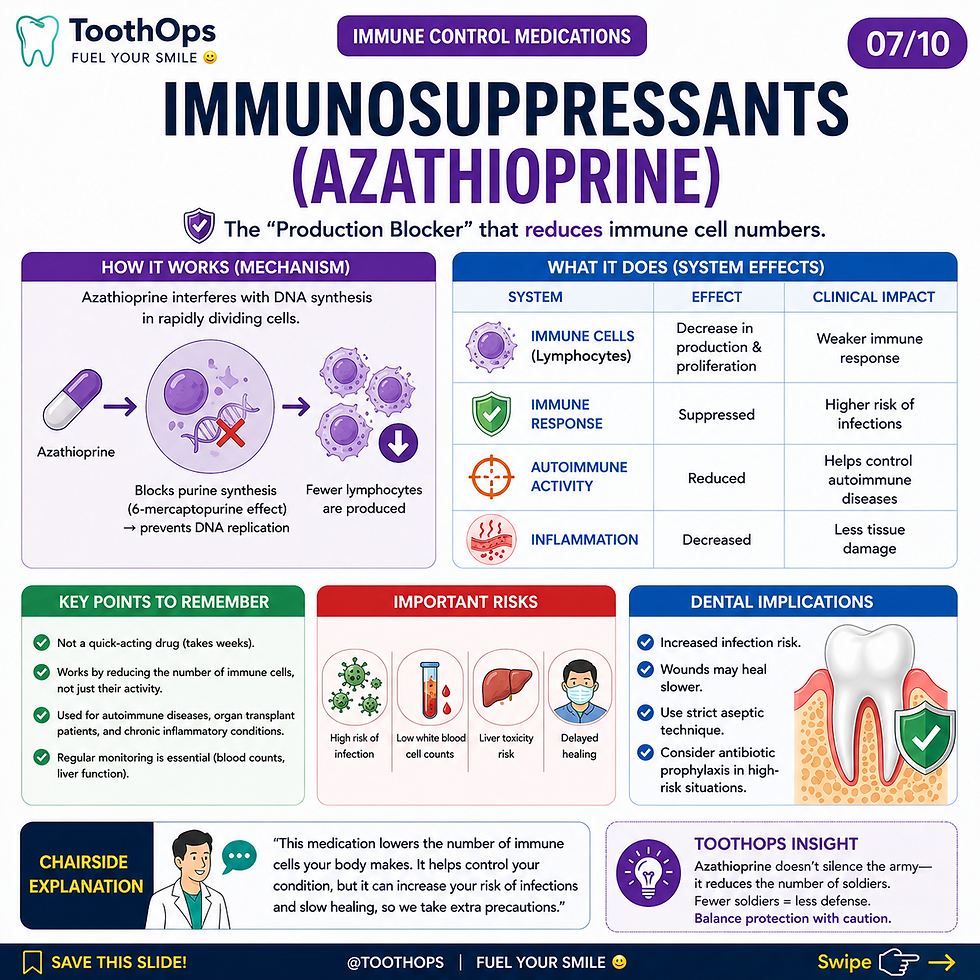
⚙️ PART 4 — AZATHIOPRINE (IMMUNOSUPPRESSANT)
🔬 Mechanism
inhibits DNA synthesis in rapidly dividing cells→ affects lymphocytes
🧠 Key Concept
It reduces the production of immune cells, not just their activity
⚠️ Clinical Effects
Effect | Outcome |
↓ lymphocyte proliferation | ↓ immune response |
↓ inflammation | disease control |
↓ defense | infection risk |
🦷 Dental Implications
higher infection susceptibility
delayed tissue repair
need for careful surgical planning
⚙️ PART 5 — INTERFERON & ANTIVIRAL THERAPY
From your study guide:
pegylated interferon
ribavirin
🔬 Mechanism
interferon → enhances antiviral immune signaling
ribavirin → inhibits viral replication
🧠 Key Insight
Not all immune drugs suppress—some redirect immune activity
⚠️ Clinical Effects
fatigue
systemic immune activation
variable response
⚙️ PART 6 — ASPIRIN (BRIDGE TO INFLAMMATION + BLEEDING)
🔬 Mechanism
inhibits COX enzyme→ ↓ prostaglandins→ ↓ inflammation
Also:
↓ thromboxane A2→ ↓ platelet aggregation
🧠 Dual Effect
System | Effect |
Inflammation | reduced |
Clotting | reduced |
🦷 Dental Relevance
increased bleeding risk
altered inflammatory response

⚙️ PART 7 — WHY THESE DRUGS CHANGE CLINICAL DECISIONS
🧠 Core Framework
When a patient is on immune-modulating drugs:
1. Healing Capacity
reduced collagen formation
delayed repair
2. Infection Risk
reduced immune surveillance
3. Bleeding Interaction
platelet + inflammatory overlap
4. Symptom Masking
inflammation signs reduced
🧠 Critical Insight
A “normal-looking” tissue may still be biologically compromised
⚙️ PART 8 — CHAIRSIDE DECISION SYSTEM (HIGH VALUE)
🧠 Before Treatment
Ask:
What medication?
What mechanism?
What system is affected?
🔬 Clinical Strategy
Scenario | Approach |
Steroids | monitor healing |
Immunosuppressed | infection control |
Aspirin | bleeding precautions |
Antiviral therapy | systemic coordination |
⚠️ HIGH-RISK SCENARIOS
🔴 Immunosuppressed Patients
increased infection risk
subtle symptoms
🔴 Chronic Steroid Use
impaired wound healing
altered inflammatory response
🔴 Combined Therapy
compounded effects
🧠 INTEGRATED SYSTEM THINKING
These drugs affect:
System | Impact |
Immune | ↓ or altered |
Vascular | permeability changes |
Healing | slowed |
Hemostasis | indirectly affected |
💬 Chairside Translation
“This medication helps control your condition, but it also changes how your body heals and responds to infection, so we’ll adjust how we manage your treatment to keep everything stable.”

✨ FINAL TAKEAWAY
Medicine doesn’t just treat disease.
👉 It reshapes the body’s internal systems.
And:
👉 Every intervention is a trade-off between control and risk
🧠 TOOTHOPS INSIGHT
The best clinicians don’t just know what a drug does
👉 They understand how it changes the system they’re working in
@ToothOps | Fuel Your Smile 😊
Stay tuned for more insights and educational content in our blog.
Disclaimer: Content is for educational purposes only and not a substitute for medical or dental care.
© 2025 ToothOps | All Rights Reserved.


Comments