🦷 Why Your Body Forms Clots When You’re Injured — And Why That Can Become Dangerous

Intrinsic, Extrinsic, and Common Pathways — Mechanism → Clinical Reality

🧠 The Big Picture (Start Here)
When tissue is injured, your body must solve two competing problems:
Stop bleeding immediately
Avoid blocking normal blood flow
To do this, it uses:
👉 a rapid, enzyme-driven cascade called the coagulation system
This system is:
sequential
amplifying
tightly regulated
👉 It is not designed for perfection.
👉 It is designed for fast survival under uncertainty.
⚙️ Core Principle (What Makes This Powerful)
Clotting is not one reaction.
It is a cascade of proteases:
inactive enzymes → activated enzymes
each step activates multiple downstream factors
👉 small trigger → exponential response
This is why:
clotting can stop bleeding quickly
but also why it can become dangerous

🔬 The Structure You Must Own
The 3 Pathways (Laboratory Model)
1️⃣ Extrinsic Pathway — Fast Trigger System
Triggered by:
👉 Tissue Factor (Factor III) released from damaged tissue
Sequence:
Tissue Factor + Factor VII → VIIa complex
activates Factor X → enters common pathway
🧠 Purpose:
rapid response to injury
“first responder system”
Clinical Insight
Measured by: PT (Prothrombin Time)
Sensitive to:
Factor VII
vitamin K status
liver function

2️⃣ Intrinsic Pathway — Amplification System
Triggered by:
👉 exposure to subendothelial collagen
Sequence:
XII → XI → IX + VIII → activates X
🧠 Purpose:
amplify clotting
build strength and sustainability
Clinical Insight
Measured by: aPTT
Sensitive to:
Hemophilia A (Factor VIII)
Hemophilia B (Factor IX)

3️⃣ Common Pathway — Final Output System
Where both pathways converge:
X → Xa
Prothrombin (II) → Thrombin (IIa)
Fibrinogen → Fibrin
👉 Fibrin forms the structural clot mesh

⚡ The Most Important Molecule (Do Not Miss This)
👉 Thrombin (Factor IIa)
Thrombin is not just an endpoint.
It is the central amplifier of the system.
What Thrombin Actually Does
converts fibrinogen → fibrin
activates Factors V, VIII, XI
activates platelets
stabilizes clot architecture
👉 creates positive feedback loops
🔥 Visualizing the Core Flow (Conceptual)
X→Xa→II→IIa→Fibrinogen→FibrinX→Xa→II→IIa→Fibrinogen→Fibrin
🧠 Mechanism → Function Mapping
Step | Mechanism | Why It Matters |
Tissue factor release | Initiation | Rapid response |
Intrinsic cascade | Amplification | Stronger clot |
Thrombin generation | Central control | Drives system |
Fibrin formation | Structural mesh | Stabilizes clot |
⚠️ Where Problems Begin (Critical Insight)
The system is built to amplify.
So when something goes wrong:
👉 the error also amplifies
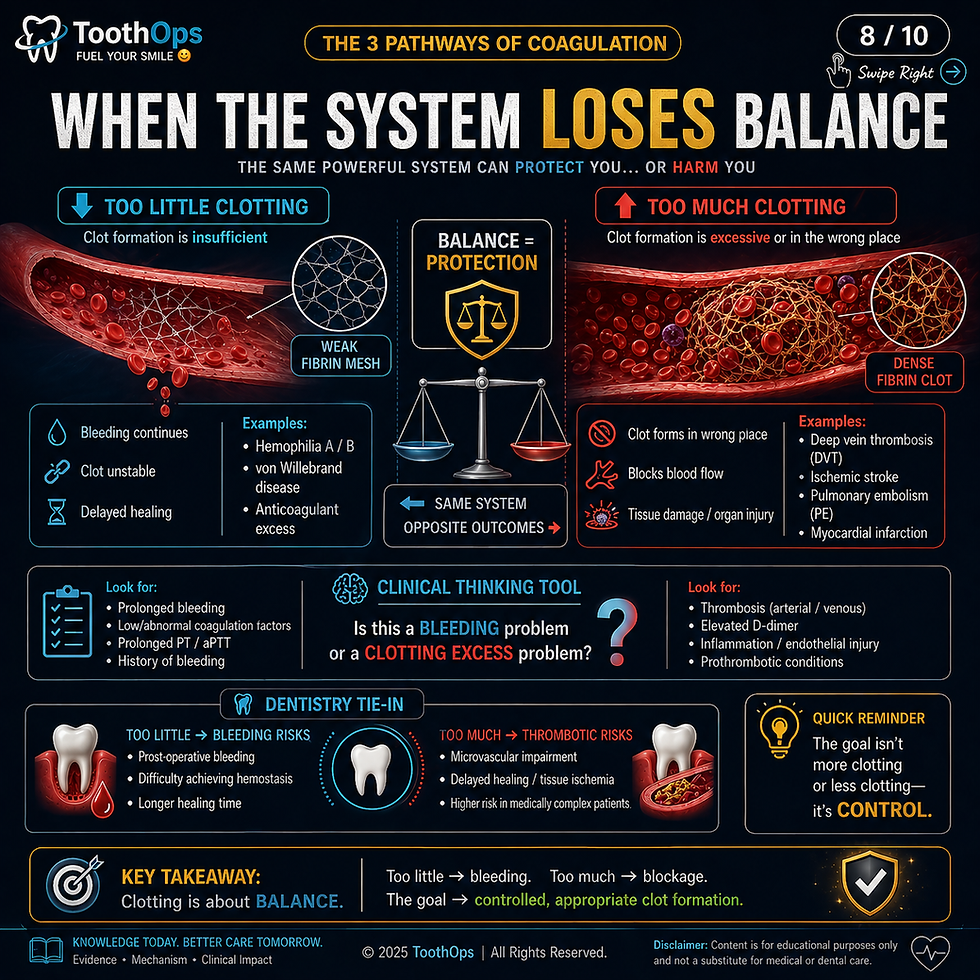
🔻 Too Little Clotting → Bleeding
clot forms slowly
clot is weak
bleeding continues
Examples:
hemophilia
anticoagulant excess
🔺 Too Much Clotting → Thrombosis
clots form without injury
vessels become blocked
Examples:
DVT
stroke
pulmonary embolism
🔬 Deep Mechanism
Thrombin Is Also an Inflammatory Signal
Thrombin:
activates endothelial cells
increases cytokine signaling
recruits immune cells
👉 coagulation and inflammation are linked systems

🔁 Connection to Complement
complement activation → endothelial injury
exposes tissue factor
activates coagulation
👉 creates a feedback loop:
inflammation → clotting
clotting → more inflammation
🦷 Clinical Dentistry Integration
🦷 Post-Extraction Healing
A clot is not just “bleeding stopped.”
It is:
👉 the foundation for tissue repair
If clot fails:
socket remains exposed
bleeding persists
healing is impaired
If clot is lost:
increased risk of dry socket
🦷 Periodontal Disease
Chronic inflammation:
activates coagulation locally
alters microvascular flow
👉 contributes to:
tissue breakdown
impaired healing
💬 Chairside Communication
Instead of:
❌ “Something is wrong with your bleeding.”
Say:
“Your body uses a clotting system to protect the area and help it heal. Our goal is to help that system form a strong, stable clot so healing can happen properly.”
🧠 Analogy
Clotting is like building a net over a hole:
extrinsic pathway → first responders
intrinsic pathway → reinforcement crew
thrombin → project manager
fibrin → structural net
👉 Too weak → hole stays open
👉 Too strong → blocks flow
⚠️ Regulation (What Prevents Disaster)
Your body balances clotting using:
Antithrombin → inhibits thrombin
Protein C & S → degrade clotting factors
Fibrinolysis (plasmin) → breaks down clots
👉 Balance is everything.

🧩 ToothOps Insight
Most people think:
“Clotting stops bleeding.”
But the deeper truth:
👉 Clotting is controlled damage containment
It:
isolates injury
stabilizes tissue
enables healing
✨ Final Takeaway
The coagulation system is:
fast
amplified
interconnected
It is not designed to be perfect.
👉 It is designed to protect you quickly—even at a cost
@ToothOps | Fuel Your Smile 😊
Stay tuned for more insights and educational content in our blog.
Disclaimer: Content is for educational purposes only and not a substitute for medical or dental care.
© 2025 ToothOps | All Rights Reserved.


Comments