Stop Memorizing “-pril, -dipine, -statin”: Follow the Vessel, Kidney, and Liver Instead

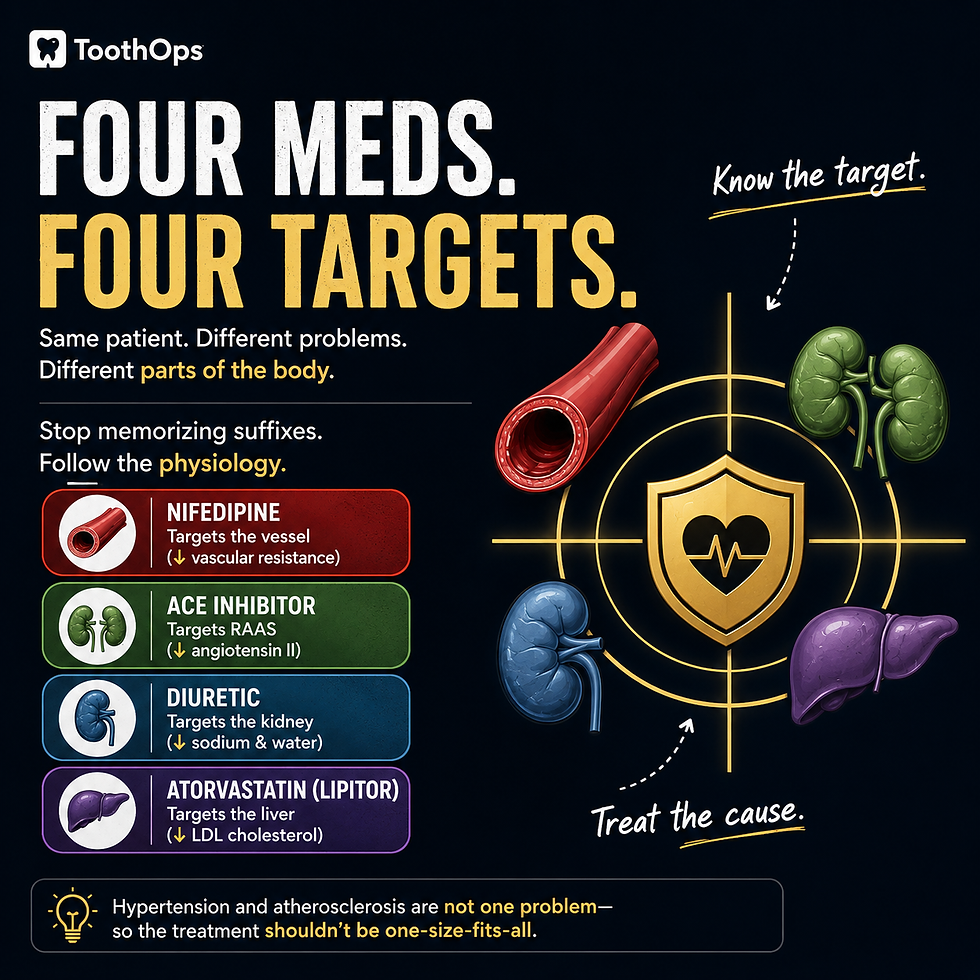
One patient. Four medications. Four different physiologic targets.
A patient opens their medication list:
Nifedipine. An ACE inhibitor. A diuretic. Atorvastatin.
It is tempting to memorize:
“-dipine = calcium blocker.”
“-pril = ACE inhibitor.”
“Statin = cholesterol.”
That may get you through one multiple-choice question.
But it does not explain why the same patient needs all four medications—or what any of them means when that patient sits in your dental chair.
A better way to learn cardiovascular pharmacology is to stop starting with the drug.
Start with the problem the drug is trying to change.
Blood pressure does not have one knob
At its simplest:
Blood Pressure ≈ Cardiac Output × Systemic Vascular Resistance
If the arteries are constricted, resistance rises.
If the circulation holds more sodium and water, blood volume rises.
If the renin–angiotensin–aldosterone system (RAAS) is activated, the body can tighten vessels while simultaneously conserving sodium and water.
And separately, if LDL-containing particles repeatedly enter damaged arterial walls, the patient can develop atherosclerosis even if today's blood pressure looks perfect.
So the treatment strategy makes much more sense when you see four different targets:
Medication | Main target | What changes? | Why it matters |
Nifedipine | Vascular smooth-muscle Ca²⁺ channels | ↓ arterial contraction | ↓ systemic vascular resistance |
ACE inhibitor | RAAS | ↓ angiotensin II + ↓ aldosterone | vasodilation + less Na⁺/water retention |
Diuretic | Kidney Na⁺ handling | ↑ Na⁺ and water excretion | ↓ circulating volume |
Atorvastatin | Hepatic cholesterol synthesis | ↑ LDL clearance | ↓ circulating LDL and vascular risk |
This is not “four drugs doing the same thing.”
It is four attacks on different parts of the cardiovascular problem.

The vessel drug: nifedipine
Nifedipine is a dihydropyridine calcium-channel blocker.
But what does calcium have to do with blood pressure?
A vascular smooth-muscle cell needs intracellular Ca²⁺ to contract.
The basic pathway is:
Ca²⁺ enters vascular smooth muscle↓Ca²⁺ binds calmodulin↓activates myosin light-chain kinase (MLCK)↓myosin interacts with actin↓artery contracts
Nifedipine interferes near the beginning.
Nifedipine → ↓ Ca²⁺ influx → ↓ smooth-muscle contraction → arterial vasodilation → ↓ systemic vascular resistance → ↓ BP
The official nifedipine labeling describes this reduction in arterial pressure as a consequence of peripheral arterial vasodilation and lower peripheral vascular resistance.
Notice what nifedipine is not doing
It does not primarily tell the kidney to excrete water.
It does not block angiotensin II.
It does not lower LDL.
It changes the arterial resistance side of the equation.
That distinction becomes useful when the patient still has hypertension despite taking nifedipine: another medication may target an entirely different physiologic driver rather than simply giving “more vasodilation.”

🦷 The dental clue hiding inside nifedipine
Calcium-channel blockers—particularly nifedipine—are associated with drug-influenced gingival enlargement.
And this is more interesting than:
“Nifedipine causes gingival hyperplasia.”
First, gingival enlargement is the better clinical term because the tissue change is not simply an increase in the number of gingival cells.
The pathogenesis appears to involve several interacting processes, including altered gingival fibroblast behavior, extracellular-matrix accumulation, inflammatory signaling, and impaired collagen degradation. Plaque-associated inflammation can amplify the problem. The exact mechanism remains incompletely defined.
So imagine what happens:
susceptible gingival fibroblast + calcium-channel blocker + plaque/inflammation↓altered connective-tissue turnover↓excess extracellular matrix/collagen accumulation↓gingival enlargement↓harder plaque control↓more inflammation↓potentially more enlargement
Now the dental relevance becomes obvious.
The medication history is not sitting in a separate medical
box.
You may literally be looking at its effect in the gingiva.
The RAAS drug: the ACE inhibitor
Now move upstream.
Suppose lowering vascular Ca²⁺ is not enough because the body is also running a hormonal system designed to preserve pressure and volume.
That system is RAAS.
Follow it:
↓ renal perfusion / sympathetic stimulation / reduced NaCl delivery
↓kidney releases renin
↓renin converts liver-produced angiotensinogen → angiotensin I
↓ACE converts angiotensin I → angiotensin II
↓angiotensin II produces:
vasoconstriction
and
aldosterone release → Na⁺ retention → water follows
So angiotensin II can increase pressure from both sides:
Tighter pipes + more fluid inside them.
An ACE inhibitor blocks the conversion of angiotensin I to angiotensin II.
ACE inhibitor → ↓ Ang II → ↓ vasoconstriction + ↓ aldosterone → ↓ vascular resistance + ↓ Na⁺/water retention
ACE also normally breaks down bradykinin, so ACE inhibition can increase bradykinin activity and contribute to vasodilation.
That same bradykinin connection helps explain two famous ACE-inhibitor adverse effects:
dry cough and, much more importantly, angioedema.
🦷 Why a dentist should care about ACE-inhibitor angioedema
Angioedema is not “just another medication side effect.”
It can involve swelling of the:
lips → tongue → floor of mouth → pharyngeal tissues
Which means it can become an airway emergency.
The patient may not present saying:
“My ACE inhibitor caused excess bradykinin.”
They may say:
“My tongue suddenly feels swollen.”
That is why medication knowledge matters clinically.
Sometimes pharmacology shows up as a gingival change.
Sometimes it shows up as an airway problem.

The kidney drug: the diuretic
Now imagine that the arteries are more relaxed and RAAS is being suppressed—but the patient is still carrying too much effective circulating volume.
This is where the kidney becomes the target.
A common antihypertensive example is hydrochlorothiazide, a thiazide diuretic.
It decreases sodium and chloride reabsorption in the distal nephron.
More sodium stays in the tubular fluid.
Water follows sodium.
↓ renal NaCl reabsorption → ↑ Na⁺ excretion → ↑ water excretion → ↓ extracellular/circulating volume → ↓ BP
Hydrochlorothiazide labeling specifically describes increased sodium and chloride excretion along with increased water excretion.
But follow the sodium one step farther.
Extra sodium reaching the distal nephron can promote exchange involving potassium and hydrogen ions.
That helps explain why thiazide therapy can contribute to:
↓ K⁺ → hypokalemia
and
loss of H⁺ → metabolic alkalosis
while also decreasing urinary calcium excretion.
This is much more useful than memorizing:
“Thiazides make you pee.”
The kidney is changing the patient's electrolyte physiology, not merely bathroom frequency.
🦷 The dental implications of “just a diuretic”
Consider what volume reduction can look like chairside.
A patient sits upright after a long appointment and becomes light-headed.
Why?
Reduced circulating volume + antihypertensive therapy can contribute to orthostatic hypotension.
So a useful dental habit is simple:
Do not immediately launch a medically complex older patient from supine to standing.
Bring the chair up gradually.
Let the patient sit.
Ask how they feel.
The medication list can sometimes predict the problem before it happens.
Diuretics and other antihypertensives may also contribute to complaints of dry mouth, which matters because reduced salivary protection can affect comfort, caries risk, plaque accumulation, and oral function.

Now the odd one out: Lipitor
Atorvastatin—Lipitor—is different.
It is not primarily a blood-pressure medication.
It targets atherosclerotic risk by changing cholesterol metabolism in the liver.
Here is the important pathway:
Acetyl-CoA↓HMG-CoA↓HMG-CoA reductase↓mevalonate↓cholesterol
Atorvastatin competitively inhibits HMG-CoA reductase, the rate-limiting enzyme in this pathway.
Most people stop there:
“Statins decrease cholesterol synthesis.”
But that misses the most useful part.
The liver responds
If hepatic cholesterol decreases, the liver does not simply shrug.
It compensates by increasing LDL receptors on hepatocytes.
Those receptors remove circulating LDL particles from the bloodstream.
So the full mechanism is:
Atorvastatin
↓HMG-CoA reductase inhibition
↓
↓ hepatic cholesterol
↓
↑ hepatic LDL receptors
↓
↑ uptake and breakdown of circulating LDL
↓
↓↓ plasma LDL
The liver is both a major site of cholesterol synthesis and LDL clearance, which is why this pathway is so effective.
That is the mechanism worth remembering.
Not:
“Statins magically remove cholesterol.”
But:
The liver senses less intracellular cholesterol and becomes better at pulling LDL out of circulation.
But why do we care so much about LDL?
Because an LDL particle can cross into the arterial intima.
There it can be retained and modified.
That attracts inflammatory cells.
Monocytes become macrophages.
Macrophages ingest lipid and become foam cells.
Over time:
LDL retention
↓
inflammation
↓
foam cells
↓
atherosclerotic plaque
↓
plaque progression or rupture
↓
thrombus
↓
myocardial infarction or ischemic stroke
So atorvastatin is not being used merely to make a laboratory number prettier.
The therapeutic goal is to decrease the number of atherogenic particles available to participate in this process.
“But doesn't Lipitor increase HDL too?”
A little—but that is not its main story.
Statins can produce a modest increase in HDL, partly through changes in lipoprotein
metabolism.
But if you are trying to understand atorvastatin pharmacology, keep your hierarchy straight:
Major effect: ↓↓↓ LDL
Also: ↓ triglycerides/VLDL
Usually: modest ↑ HDL
Do not turn a statin into an “HDL medication.”
Its major clinical power comes from reducing atherogenic LDL-containing particles and cardiovascular events.

🦷 The clue: “My legs keep cramping”
Now suppose your patient taking Lipitor says:
“My legs have been aching lately.”
That deserves your attention.
Statins can cause muscle symptoms, ranging from myalgia to uncommon but serious muscle injury.
The pharmacology connection is:
statin exposure↓muscle symptoms in susceptible patients↓pain / tenderness / weakness↓sometimes ↑ creatine kinase (CK)
That does not mean every leg cramp in a patient taking a statin is caused by the statin.
But the medication belongs in the differential.
That is the kind of reasoning a medication history should create.
Four drugs. Now follow the physiology.
Here is the entire story without memorizing a drug list:
Problem: the arteries are too constricted
Nifedipine→ ↓ Ca²⁺ entry into vascular smooth muscle→ arteries relax→ ↓ systemic vascular resistance
Problem: RAAS is maintaining pressure and volume
ACE inhibitor→ ↓ angiotensin II→ ↓ vasoconstriction + ↓ aldosterone→ ↓ resistance + ↓ sodium/water retention
Problem: the circulation is carrying more sodium and water than needed
Diuretic→ kidney excretes more Na⁺→ water follows→ ↓ circulating volume
Problem: atherogenic LDL is contributing to plaque formation
Atorvastatin→ ↓ hepatic cholesterol synthesis→ ↑ hepatic LDL receptors→ ↓ circulating LDL→ ↓ future atherosclerotic risk
Now four seemingly random medications become one coherent cardiovascular strategy.

Why would one patient need three antihypertensives?
Because hypertension is not one mechanism.
One patient can simultaneously have:
increased vascular tone + RAAS activity + sodium retention + vascular remodeling
Trying to control all of that through one pathway may be less effective than combining medications that act at complementary sites.
Think of it less like increasing the volume on one drug—
and more like closing several physiologic escape routes.
Nifedipine: relax the artery.
ACE inhibitor: quiet the hormonal pressure system.
Diuretic: unload sodium and water.
This is why learning the system scales much better than memorizing individual prescriptions.
🦷 And the mouth gives you clues about the medications
Here is where systemic pharmacology becomes dental pharmacology.
Medication | Systemic purpose | Dental/clinical clue worth remembering |
Nifedipine | Vasodilation | Gingival enlargement |
ACE inhibitor | RAAS suppression | Dry cough; rare but important angioedema |
Diuretic | Na⁺/water removal | Orthostatic symptoms; possible xerostomia |
Atorvastatin | LDL reduction | Ask about unexplained muscle pain/weakness |
A medication list should not be something you copy into the chart and forget.
It can predict:
what you may see, what the patient may report, and what could matter during treatment.
A better way to answer pharmacology questions
When an exam asks:
“What is the mechanism of nifedipine?”
Do not begin with the answer choices.
Ask:
Where does this drug act?
Vascular smooth muscle.
What does that tissue need to contract?
Ca²⁺.
What happens if Ca²⁺ entry falls?
Less contraction.
What happens to systemic vascular resistance?
It falls.
What happens to blood pressure?
It falls.
You just reconstructed the answer.
Do the same thing with every drug.
The four anchors worth remembering
Nifedipine = VESSEL
ACE inhibitor = RAAS
Diuretic = KIDNEY
Atorvastatin = LIVER / LDL
Everything else can grow from those anchors.
ToothOps Takeaway
Medication names become much easier when you stop treating them as vocabulary words.
Follow the physiology:
Ca²⁺ controls contraction. Block it → the artery relaxes.
Angiotensin II preserves pressure. Block its formation → vessels relax and aldosterone falls.
Sodium holds water in the circulation. Excrete it → volume falls.
The liver controls much of LDL metabolism. Reduce hepatic cholesterol → LDL receptors rise → circulating LDL falls.
And then bring it back to dentistry:
Nifedipine may show up in the gingiva.
ACE inhibition may show up as cough—or rarely airway-threatening angioedema.
Diuresis may show up when the patient becomes dizzy getting out of your chair.
A statin may show up when the patient mentions unexplained muscle pain.
The medication list is not separate from the dental exam.
It is another map of the patient's physiology.
Quick Mechanism Map
NifedipineL-type Ca²⁺ channel inhibition→ ↓ vascular smooth-muscle contraction→ arterial vasodilation→ ↓ SVR→ ↓ BP
ACE inhibitor↓ Ang I → Ang II conversion→ ↓ vasoconstriction + ↓ aldosterone→ ↓ SVR + ↓ volume→ ↓ BP
Thiazide diuretic↓ renal NaCl reabsorption→ ↑ Na⁺/water excretion→ ↓ circulating volume→ ↓ BP
Atorvastatin↓ HMG-CoA reductase→ ↓ hepatic cholesterol→ ↑ LDL receptors→ ↑ LDL clearance→ ↓ plasma LDL
@ToothOps | Fuel Your Smile 😊
Stay tuned for more insights and educational content in our blog.
Disclaimer: Content is for educational purposes only and not a substitute for medical or dental care.
© 2026 ToothOps | All Rights Reserved.
ToothOps educational content is designed to support clinical reasoning and learning. It does not replace patient-specific medical evaluation, prescribing guidance, or institutional protocols.


Comments