🦷 Why Your Body Filters Everything Before It Reaches Your Bloodstream

The Liver as a Selective Interface Between the Gut and the Body
🔍 Introduction
After digestion, substances absorbed from the gastrointestinal tract—including nutrients, microbial products, and environmental compounds—do not enter systemic circulation directly.
Instead, they are routed through the liver before reaching the rest of the body.
This system functions as a controlled biological checkpoint, ensuring that what enters your bloodstream has been evaluated, modified, or cleared when necessary.
🧠 Core Principle
The liver performs three integrated roles:
Filtration — removal of pathogens and debris
Biotransformation — chemical modification of substances
Immune regulation — balancing tolerance and response
Together, these determine what is allowed into circulation.
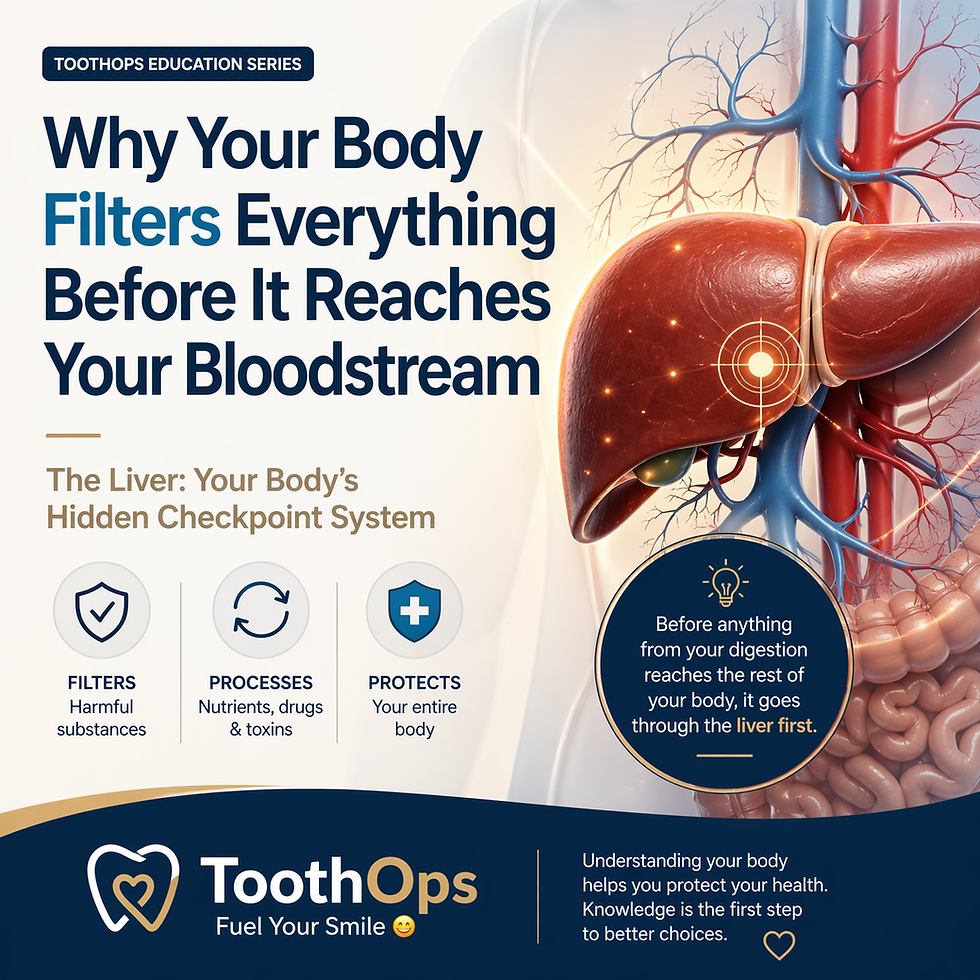
⚙️ Portal Circulation — The First-Pass System
Blood from the digestive tract follows a distinct pathway:
intestines → mesenteric veins → hepatic portal vein → liver → systemic circulation
📊 Table 1 — Portal vs Systemic Circulation
Feature | Portal Circulation | Systemic Circulation |
Source | GI tract, spleen, pancreas | Heart → entire body |
Destination | Liver first | Direct tissues |
Purpose | Pre-systemic processing | Distribution |
Content | Nutrients, toxins, bacteria | Oxygenated blood, processed metabolites |
👉 Key Insight:Portal circulation exists to ensure evaluation before exposure.

⚙️ Sinusoidal Architecture — Why Liver Blood Flow Is Unique
Inside the liver, blood does not move like typical circulation.
It flows through sinusoids, which are specialized channels designed for exchange.
📊 Table 2 — Sinusoids vs Normal Capillaries
Feature | Sinusoids (Liver) | Typical Capillaries |
Endothelium | Discontinuous | Continuous |
Flow speed | Slow | Faster |
Permeability | High | Moderate |
Function | Exchange + immune contact | Nutrient exchange |
👉 Clinical Meaning: Slower, more permeable flow allows time for filtering and decision-making.

⚙️ Cellular Coordination — Who Does the Work?
The liver is not a single-function organ.It is a coordinated cellular system.
📊 Table 3 — Key Liver Cells and Their Roles
Cell Type | Function | Clinical Relevance |
Hepatocytes | Metabolism, protein synthesis, bile production | Drug metabolism, liver disease |
Kupffer Cells | Phagocytosis of bacteria and debris | Infection control, inflammation |
Endothelial Cells | Regulate exchange and flow | Vascular function |
Stellate Cells | Store vitamin A, fibrosis regulation | Liver fibrosis (disease state) |
👉 Key Insight: The liver is both a metabolic organ and an immune organ.
⚙️ Biotransformation — What “Detox” Actually Means
The liver modifies substances through enzyme-driven pathways.
📊 Table 4 — Phase I vs Phase II Reactions
Phase | Process | Purpose | Clinical Note |
Phase I | Oxidation, reduction | Introduce functional groups | Can activate or inactivate drugs |
Phase II | Conjugation (glucuronidation, sulfation) | Increase solubility | Enables excretion |
👉 Important Detail:Some substances become more active or toxic after Phase I, not less.
⚙️ Immune Tolerance — A Unique Liver Function
The liver must constantly decide:
what to react to
what to tolerate
Because it is exposed to:
food-derived antigens
microbial products
📊 Table 5 — Immune Activation vs Immune Tolerance
Process | Outcome | Purpose |
Immune Activation | Inflammation, pathogen clearance | Defense |
Immune Tolerance | Reduced response to harmless antigens | Prevent overreaction |
👉 Key Insight:The liver prevents unnecessary inflammation while still enabling defense.
🦷 Oral-Systemic Connection (ToothOps Layer)
In periodontal inflammation:
vascular permeability increases
epithelial barriers weaken
bacteria can enter circulation
📊 Table 6 — Oral Inflammation → Systemic Impact Pathway
Step | Event | Result |
1 | Gingival inflammation | Increased permeability |
2 | Bacterial entry into bloodstream | Transient bacteremia |
3 | Circulation to liver | Immune filtering |
4 | Hepatic immune activation | Systemic signaling |
👉 Clinical Meaning:The liver helps buffer systemic exposure—but repeated input increases overall load.

🧠 Clinical Interpretation
This system explains:
why not all exposures lead to disease
why chronic inflammation has systemic effects
why drug responses vary between individuals
📊 Table 7 — Why This Matters Clinically
Scenario | Liver Role | Outcome |
Infection exposure | Filters pathogens | Prevents systemic spread |
Drug intake | Metabolizes compounds | Determines effect and toxicity |
Chronic inflammation | Regulates immune signals | Influences systemic health |
🧾 Summary
Blood from the gastrointestinal tract passes through the liver before entering systemic circulation. Within the liver, sinusoidal architecture enables interaction between blood, hepatocytes, and immune cells. Hepatocytes metabolize substances through phase I and II reactions, while Kupffer cells provide immune surveillance. The liver also balances immune activation and tolerance, preventing excessive inflammatory responses. This system connects digestion, immunity, and systemic health, including pathways linking oral inflammation to whole-body effects.
✨ Closing Perspective
The liver operates continuously as a regulatory interface—filtering, modifying, and distributing what enters the body.
Most of this work is not perceived.
Yet it is essential for maintaining internal stability in a constantly changing external environment.
@ToothOps | Fuel Your Smile 😊
Stay tuned for more insights and educational content in our blog.
Disclaimer: Content is for educational purposes only and not a substitute for medical or dental care.
© 2025 ToothOps | All Rights Reserved.


Comments