🦷 Why Some Bleeding Happens Immediately… and Some Happens Later

A ToothOps Guide to Hemophilia, von Willebrand Disease, and the Timing of Bleeding

🧠 Start Here (The Insight Most People Miss)
Not all bleeding starts the same way.
Some bleeding:
starts immediately
Others:
starts hours later
👉 That difference is not random.
It is one of the most powerful diagnostic clues in medicine.
🔥 The ToothOps Rule (Memorize This)
If bleeding starts immediately → think plateletsIf bleeding starts later → think clotting factors
🧠 Why This Works (Big Picture)
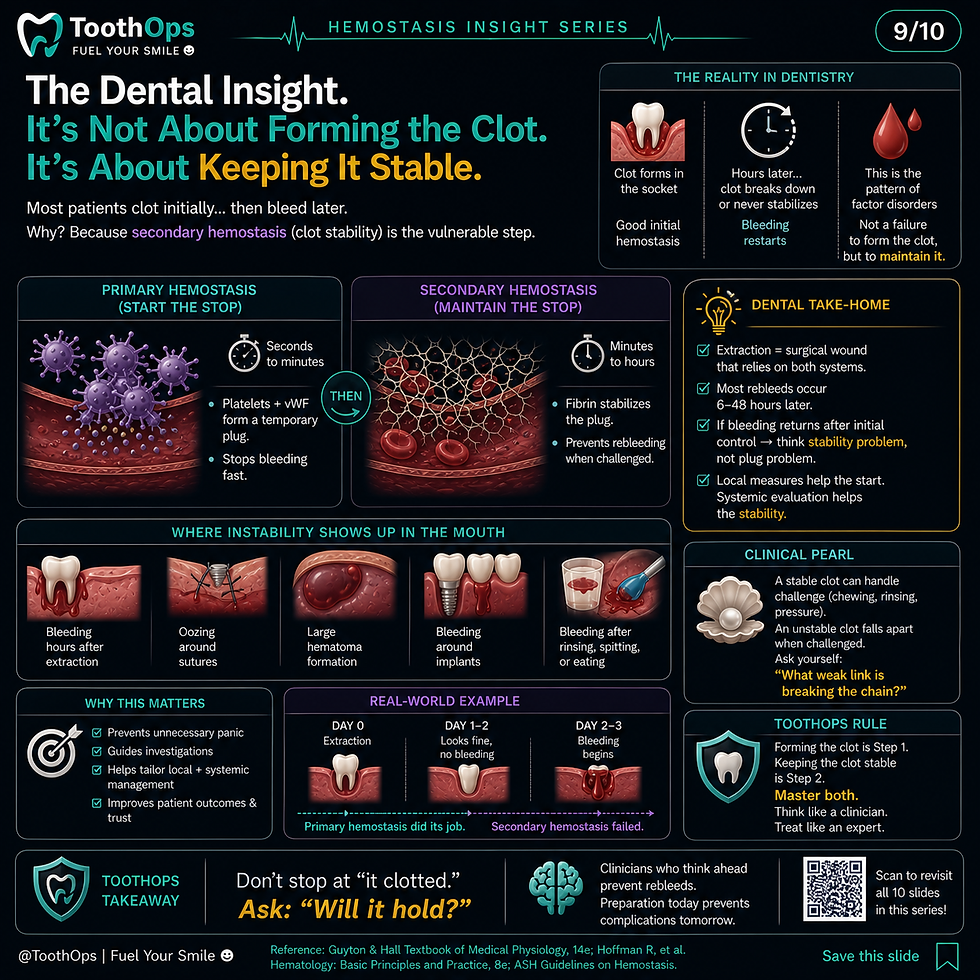
Hemostasis has two early layers:
Primary hemostasis → stops bleeding fast
Secondary hemostasis → keeps bleeding stopped
👉 If the first fails → bleeding begins right away
👉 If the second fails → bleeding returns later

⚙️ Step 1 — Primary Hemostasis (Immediate Control)
This is the first response system.
platelets adhere
platelets activate
platelets aggregate
👉 temporary plug forms within seconds
🧬 Key Player: von Willebrand Factor (vWF)
vWF:
anchors platelets to injured vessels
stabilizes Factor VIII
👉 it connects platelets + coagulation
⚠️ When This Fails (Platelet / vWF Disorders)
👉 Bleeding pattern:
immediate
superficial
persistent oozing
🧠 Clinical Clues
gum bleeding during brushing
nosebleeds
easy bruising
prolonged bleeding during procedures
🦷 Chairside Translation
“If bleeding starts right away and doesn’t stop easily, the platelet system may not be working efficiently.”
⚙️ Step 2 — Secondary Hemostasis (Delayed Stability)
After the platelet plug forms:
coagulation cascade activates
thrombin is generated
fibrin stabilizes the clot
👉 This process takes minutes to hours
⚠️ When This Fails (Clotting Factor Disorders)
👉 Bleeding pattern:
initially stops
then returns later
🧠 Clinical Clues
bleeding hours after extraction
swelling from internal bleeding
joint bleeding (hemarthrosis)
🦷 Chairside Translation
“If bleeding starts later, it usually means the clot formed—but didn’t become strong enough.”

🧬 Hemophilia: The Classic Delayed Bleeding Disorder
Hemophilia A (Factor VIII)
intrinsic pathway defect
reduced thrombin amplification
Hemophilia B (Factor IX)
same system failure
affects intrinsic tenase complex
🧠 Signature Pattern
👉 Delayed bleeding after injury
Why?
Because:
platelet plug forms normally
BUT fibrin reinforcement is weak
👉 clot breaks later
🧬 Hemophilia C (Factor XI) — The Subtle One
🧠 Key Insight
Factor XI affects:👉 amplification phase
Clinical Reality
bleeding is variable
often triggered by procedures
👉 not always predictable
🧩 von Willebrand Disease (The Overlap Disorder)
🧠 Why It’s Different
vWF affects BOTH:
platelet adhesion
Factor VIII stability
Result
👉 mixed bleeding pattern:
immediate bleeding (platelet issue)
sometimes prolonged bleeding (factor effect)
🧠 Signature Pattern
gum bleeding
nosebleeds
prolonged oozing after dental work
⚠️ Why It’s Missed
labs may be normal
symptoms subtle
👉 history matters more than labs

🔁 The Deeper Insight
Primary hemostasis:
👉 prevents bleeding from starting
Secondary hemostasis:
👉 prevents bleeding from returning
🔥 This is the key shift
You are no longer asking:
“Does the patient bleed?”
You are asking:
“Does bleeding start—or does it come back?”

📊 Pattern Recognition Table
Feature | Platelet / vWF Problem | Factor Problem |
Timing | Immediate | Delayed |
Location | Surface (gums, skin) | Deep (joints, muscle) |
Examples | vWD, thrombocytopenia | Hemophilia A/B |
Mechanism | Plug formation fails | Clot stabilization fails |
🦷 Dentistry Application (Where This Matters Most)
This explains why:
some patients bleed during procedures
others bleed after leaving the clinic
🧠 High-Yield Insight
👉 Most post-op bleeding = secondary hemostasis issue
Clinical Approach
Instead of reacting to bleeding:
👉 Predict it using:
timing
pattern
mechanism

💬 Chairside Communication
“Your body forms an initial clot quickly, but in your case, the part that strengthens the clot may not work as effectively, so we take extra steps to protect the area.”
🧠 ToothOps Insight
The body does not fail randomly.
👉 It reveals patterns through time and behavior
Understanding:
when bleeding starts
how it behaves
👉 turns confusion into diagnosis
✨ Final Takeaway
Bleeding timing is not a detail.
👉 It is a diagnostic signal
🪶 ToothOps Line
Immediate bleeding tells you what failed first.Delayed bleeding tells you what failed to hold.
@ToothOps | Fuel Your Smile 😊
Stay tuned for more insights and educational content in our blog.
Disclaimer: Content is for educational purposes only and not a substitute for medical or dental care.
© 2025 ToothOps | All Rights Reserved.


Comments