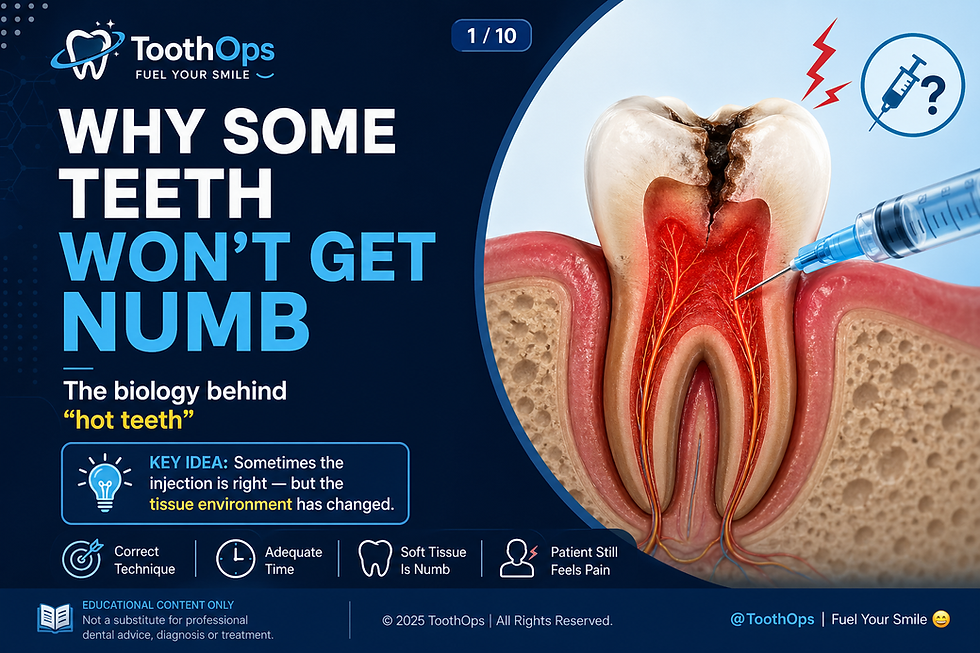
🦷 Why Local Anesthesia Fails in Inflamed Teeth
- ToothOps

- May 6
- 3 min read
Understanding the Biology Behind “Hot Teeth”
🔍 Introduction
Few moments in clinical dentistry are more frustrating than when local anesthesia appears to fail.
The injection is placed correctly
The technique is sound
Adequate time is given
Yet the patient continues to feel pain.
At first, this is often interpreted as a technical problem.
In many cases, however, the issue is not technical.
👉 It is biological.
🧠 The Problem of Assumption
Local anesthesia is often approached as a simple procedural step:
deliver the drug
wait for onset
proceed with treatment
This assumes that drug delivery alone determines success.
In reality, anesthetic effectiveness depends on:
local tissue environment
physiologic state of the nerve
When these are altered, even correct technique may not produce the expected outcome.
⚙️ Pharmacologic Principles in Context
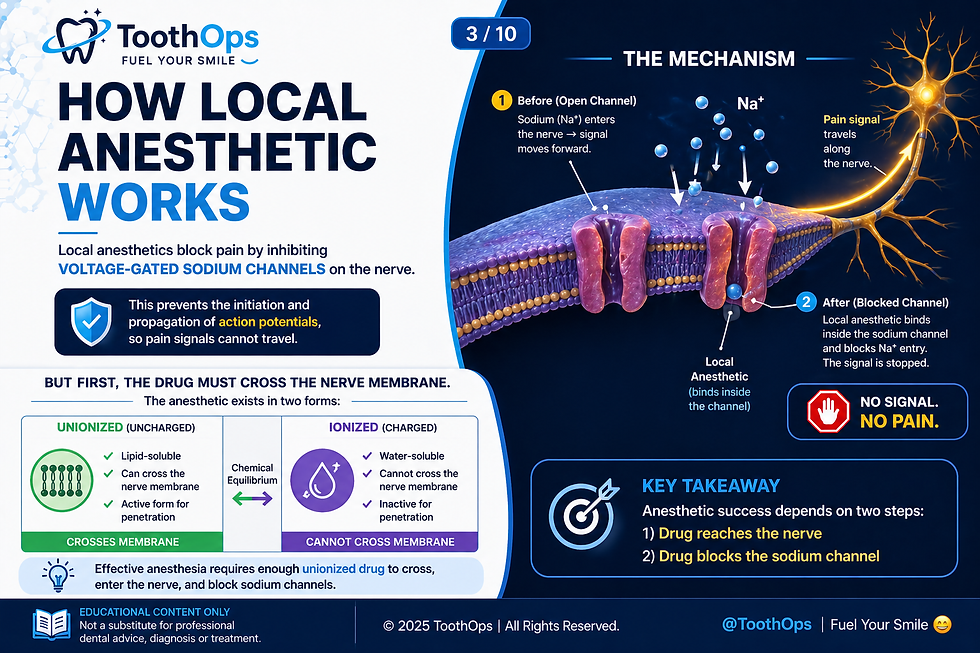
Local anesthetics block pain by:
👉 inhibiting voltage-gated sodium channels→ preventing propagation of action potentials
For this to occur, the drug must cross the nerve membrane.
This depends on a chemical equilibrium:
Form | Property | Function |
Unionized (uncharged) | Lipid-soluble | Crosses nerve membrane |
Ionized (charged) | Water-soluble | Cannot cross membrane |
👉 Effective anesthesia requires sufficient unionized drug.

🔬 What Changes in Inflamed Tissue
Inflamed tissue becomes more acidic (↓ pH).
This shifts the equilibrium:
↑ ionized form
↓ unionized form
👉 Result:
reduced membrane penetration
decreased intracellular drug concentration
🧠 Neural Sensitization (Why Pain Feels Worse)
At the same time, inflammation alters nerve behavior.
Key mediators released:
Prostaglandins (PGE₂)
Bradykinin
🔬 Effects of these mediators:
Prostaglandins:
↑ sodium channel activity
↓ activation threshold
👉 nerves fire more easily
Bradykinin:
directly activates nociceptors
↑ vascular permeability
triggers release of:
substance P
CGRP
👉 amplifies and sustains pain signaling

🔗 The Combined Effect (Critical Concept)
Two changes occur simultaneously:
Factor | Effect |
↓ Drug penetration | Less anesthetic reaches nerve |
↑ Nerve excitability | Stronger, persistent signaling |
👉 This explains why:
anesthesia appears ineffective
pain persists despite correct technique

🧩 Why Repeating the Same Injection Fails
Repeating the same injection does NOT change:
tissue pH
drug ionization balance
nerve sensitization
👉 Result:
more volume
same limitation
This is why repeated injections without strategy change often lead to:
patient discomfort
clinical frustration
🧭 Clinical Implications
Management should shift from repetition → strategy:
Adjust delivery:
intraosseous injection
periodontal ligament (PDL) injection
Improve diffusion:
consider articaine
Anticipate difficulty:
“hot teeth”
lingering or spontaneous pain
👉 These findings are not separate—they reflect the same inflammatory state.

💡 For Patients
Difficulty getting numb can feel concerning.
In inflamed teeth, this can be expected.
Helpful observations to share:
Does the pain linger after stimulus?
Does it happen on its own?
Is it difficult to localize?
👉 These details help guide treatment decisions more effectively.
🧠 For Students and Clinicians
Anesthetic success depends on more than technique.
Evaluate:
tissue pH
drug ionization state
nociceptor sensitivity
inflammatory mediator activity
👉 Think in sequence:
Environment → Drug behavior → Nerve response → Outcome
🏁 Final Thought
When anesthesia fails, the instinct is to question technique.
A more useful question is:
👉 What has changed in the biology of this tissue?
Understanding that shift transforms anesthesia from a procedure into a process of clinical reasoning.

@ToothOps | Fuel Your Smile 😊
Stay tuned for more insights and educational content in our blog.
Disclaimer: Content is for educational purposes only and not a substitute for medical or dental care.
© 2025 ToothOps | All Rights Reserved.


Comments