🩸 Why Gums Bleed: What Your Body Is Trying to Tell You

Many people notice a small amount of blood when brushing or flossing and assume one of two things:
“I must be brushing too hard.”
“This probably isn’t important.”
Both reactions are understandable. Gum bleeding is extremely common, and because it often occurs without pain, it’s easy to ignore.
But biologically, bleeding gums are rarely random. They usually reflect how the body is responding to inflammation at the gumline.
Understanding why this happens can help dental students, clinicians, and patients recognize a pattern the body is trying to signal.

🧬 What’s Actually Happening in the Body
At the simplest level, gum bleeding is usually linked to inflammation in the gingival tissues.
The process often begins with dental plaque, a structured biofilm that forms naturally on tooth surfaces.
If plaque remains along the gumline, bacteria inside the biofilm release substances that trigger an immune response.
This activates the body’s inflammatory defense system.
Key biological events:
🦠 Bacterial signals activate immune cells
Neutrophils (first responders of the immune system) migrate to the gum tissue.
These cells release antimicrobial molecules to control bacteria.
🔥 Inflammatory mediators are released
Chemical signals such as:
cytokines
prostaglandins
histamine
increase blood flow to the tissue.
🩸 Small blood vessels become more permeable
The capillaries in the gums dilate and become fragile.
This allows immune cells to reach the infection site—but it also makes the tissue easier to bleed when mechanically disturbed.

🔍 Why Brushing or Flossing Triggers the Bleeding
Healthy gum tissue is typically firm and resistant to minor mechanical pressure.
Inflamed gum tissue behaves differently.
When inflammation is present:
the tissue becomes swollen
the epithelium becomes thinner
capillaries sit closer to the surface
When a toothbrush or floss passes through the area, these fragile capillaries may rupture easily, producing bleeding.
This is why bleeding often appears during oral hygiene rather than spontaneously.
The brushing itself is not the cause—the inflammation underneath is.

🧠 The Immune System’s Role
The immune response in gum tissue follows a recognizable pattern.
Early inflammatory response
🧪 Neutrophils arrive first
They migrate through blood vessels toward bacterial signals.
Their goal is to neutralize microbes.
Secondary immune activity
🦠 Monocytes and macrophages follow
These cells remove damaged tissue and bacteria.
They help coordinate further immune signaling.
This process is part of the body’s normal defense system.
However, when plaque remains undisturbed over time, the immune response can remain chronically activated, which leads to persistent inflammation in the gums.

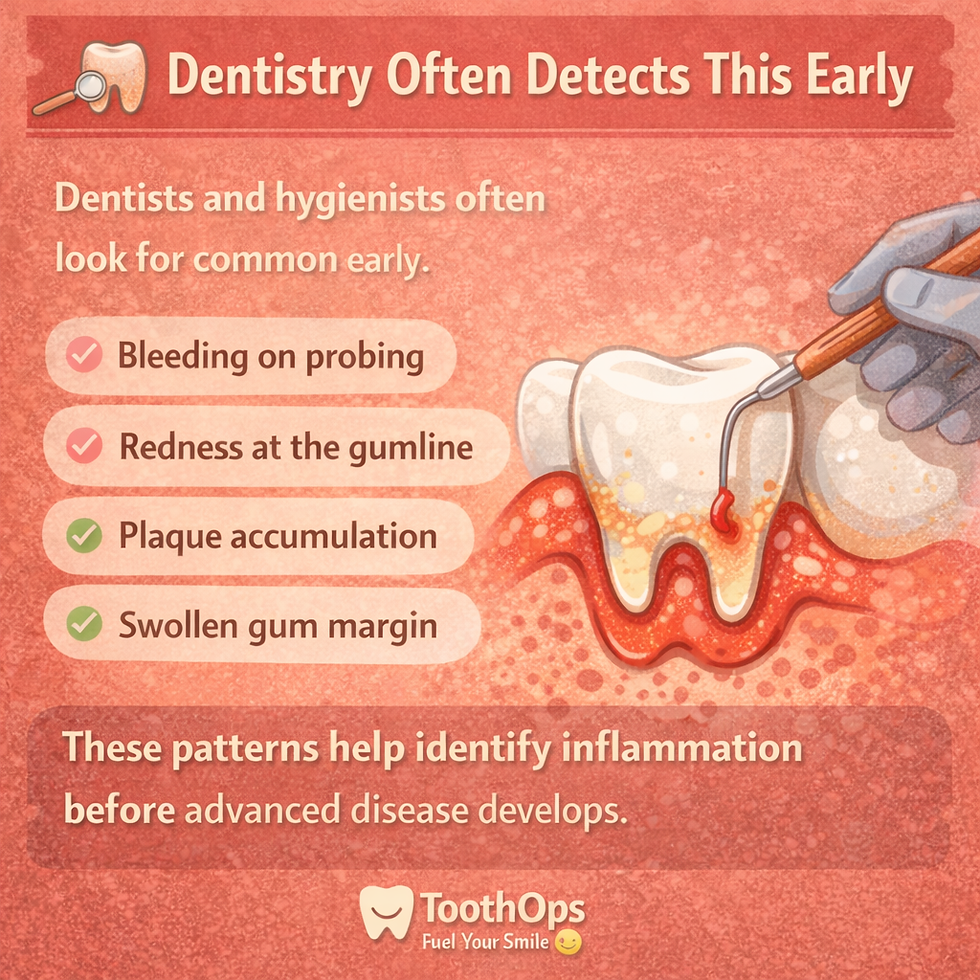
🦷 Why Dentistry Often Notices This Early
Dentists and hygienists frequently see the earliest signs of inflammation during routine examinations.
Common early indicators include:
bleeding during probing
redness along the gum margin
slight swelling between teeth
plaque accumulation near the gingiva
These observations allow dental professionals to recognize patterns before more advanced tissue changes develop.
Because oral tissues respond quickly to bacterial accumulation, the mouth can sometimes serve as an early window into inflammatory processes occurring in the body.
📚 The Health Literacy Gap
Many patients interpret bleeding gums in ways that unintentionally delay care.
Common assumptions include:
❌ “If it doesn’t hurt, it’s probably fine.”
❌ “Bleeding means I should stop flossing.”
❌ “My gums are just sensitive.”
In reality, bleeding is often the body’s way of signaling ongoing inflammation.
Understanding the biological mechanism behind this symptom can shift the perspective from fear or avoidance toward curiosity and awareness.

🌿 What Clarity Changes
When people understand why gums bleed, several helpful shifts occur:
✔ oral hygiene becomes more intentional
✔ plaque removal becomes more consistent
✔ routine dental visits feel more purposeful
✔ early inflammatory changes are addressed sooner
In other words, understanding the biology changes behavior naturally, without pressure or alarm.
🪥 ToothOps Takeaway
🧬 Gum bleeding is most often a sign of inflammation in the gingival tissues.
🦠 Bacterial plaque triggers an immune response that increases blood flow and vascular fragility.
🩸 Inflamed gums bleed more easily because capillaries become dilated and fragile.
🦷 Dentists frequently identify these patterns early during routine examinations.
🌱 Understanding the underlying biology helps people approach oral health with curiosity rather than fear.

💭 Reflection Question
Next time you notice bleeding while brushing or flossing, consider:
What might the body be responding to in that moment?
Understanding that question is often the first step toward recognizing the patterns behind oral health.
@ToothOps | Fuel Your Smile 😊
Stay tuned for more insights and educational content in our blog.
Disclaimer: Content is for educational purposes only and not a substitute for medical or dental care.
© 2025 ToothOps | All Rights Reserved.


Comments