🦷Why Gums Bleed — The Microvascular Signals of Inflammation, Injury, and Systemic Disease


🧠 Start Here: The Real Question
When patients say:
“My gums bleed when I brush”
Most assume:
👉 “I brushed too hard”
But the real question is:
👉 “Why are these blood vessels so easy to disrupt?”
Because healthy gums:
👉 do NOT bleed easily
🧠 Core Insight
Gum bleeding is not random—it is a microvascular signal that something has changed beneath the surface
🧩 The Hidden System: Gingival Vasculature
The gingiva is not just soft tissue.
👉 It is a highly vascular, dynamic network

🔬 Three Primary Sources of Blood Supply
From your study guide:
Supraperiosteal vessels
Periodontal ligament vessels
Alveolar bone vessels
👉 These vessels interconnect to form dense capillary networks
🔬 Key Vascular Structures
Subepithelial plexus → supplies outer gingiva
Dento-gingival plexus → beneath junctional epithelium
👉 In healthy tissue:
tightly organized
stable
resistant to disruption
🧠 ToothOps Insight
Healthy gums are structurally protected—not fragile

⚙️ What Changes When Gums Start Bleeding
Bleeding is not caused by brushing.
👉 It is caused by vascular instability
🔬 Inflammation Changes the System
From your study guide:
vessels become:
dilated
looped
irregular
capillaries become fragile
inflammatory cells infiltrate tissue
collagen support is disrupted
🧠 Core Insight
Inflammation transforms stable vessels into fragile ones

⚠️ The Real Mechanism of Gum Bleeding
Step-by-Step Breakdown
Plaque → bacterial toxins
Immune response activates
Cytokines released
Blood vessels:
dilate
become permeable
Structural support weakens
Minor stimulation → bleeding
🧠 ToothOps Insight
Bleeding is not damage—it is a sign of inflammatory amplification

⚙️ Types of Gingival Injury
🦷 Abrasion
superficial epithelial damage
🦷 Contusion
subepithelial bleeding without break
🦷 Laceration
deeper tissue disruption
👉 These all interact with vascular system differently
🧠 Insight
The same trauma produces different bleeding depending on vascular condition
🔁 Local vs Systemic Bleeding
This is where the blog becomes clinically powerful.
🧠 Two Categories
1. Local Causes
gingivitis
periodontitis
trauma
2. Systemic Causes
platelet disorders
coagulation disorders
medications
🧠 Core Insight
The mouth often reveals systemic disease before the rest of the body

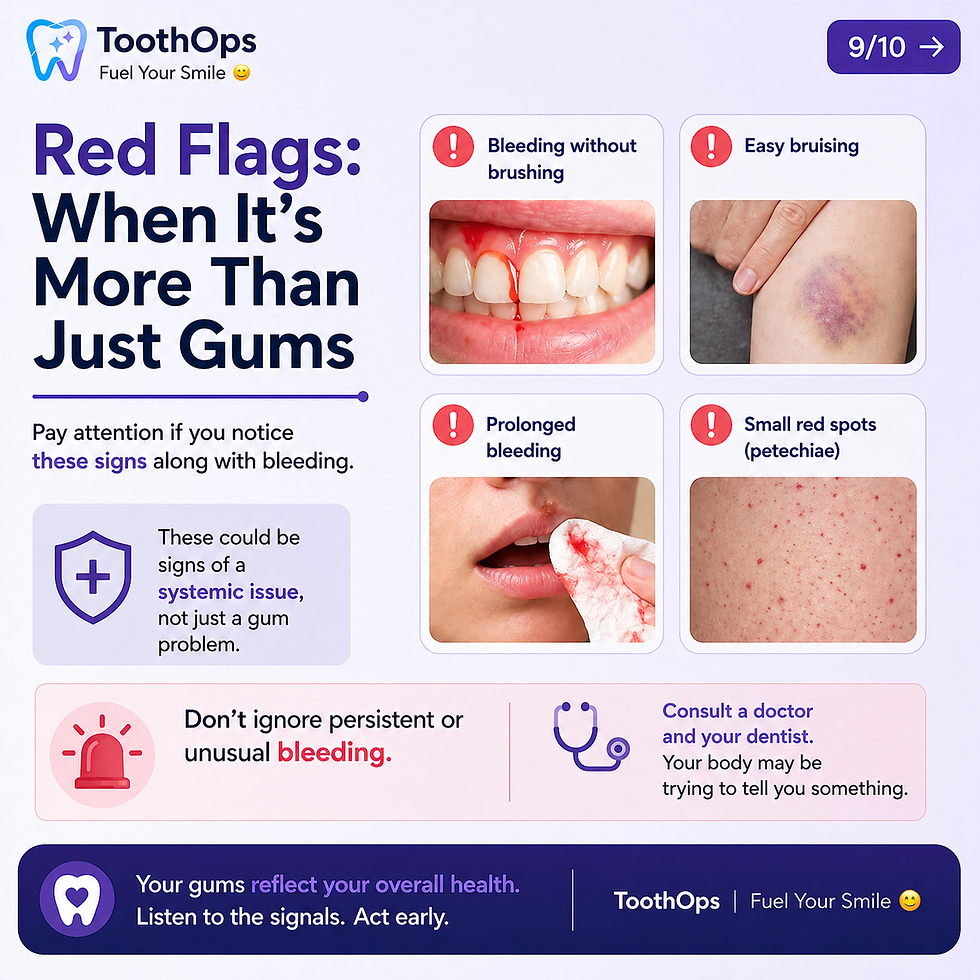
⚠️ When Gum Bleeding Is NOT “Just Gingivitis”
🚨 Red Flags
spontaneous bleeding
bleeding without brushing
petechiae
prolonged bleeding after dental work
👉 These may indicate:
thrombocytopenia
platelet dysfunction
clotting factor issues
🔬 The Role of Hemostasis
When vessels break:
vasoconstriction
platelet plug formation
coagulation cascade
BUT:
👉 In inflamed tissue:
vessels are fragile
clot formation is less effective
bleeding persists longer
🧠 Insight
Bleeding is not just vessel rupture—it is failure of balance between injury and repair
⚙️ Why Bleeding Can Worsen Over Time
Positive Feedback Loop
inflammation → vascular damage
bleeding → more inflammation
tissue breakdown → deeper pockets
👉 cycle continues
🧠 ToothOps Insight
Bleeding is not a symptom—it is a progressive signal
🦷 Chairside Clinical Application
Step 1 — Identify Pattern
Ask:
when does bleeding occur?
spontaneous or provoked?
Step 2 — Assess Tissue
redness
swelling
pocket depth
Step 3 — Consider Systemic Factors
medications
medical history
labs (if needed)
Step 4 — Treat Accordingly
Cause | Approach |
Plaque-induced | hygiene + scaling |
Trauma | reduce irritation |
Systemic | coordinate care |
🧠 ToothOps Insight
Treat the cause—not just the bleeding
💬 Chairside Translation
“Healthy gums don’t bleed easily. When they do, it usually means the tissue underneath is inflamed and the blood vessels are more fragile. Our goal is to reduce that inflammation so your gums can return to a stable state.”
✨ Final Takeaway
Gum bleeding is not about brushing.
👉 It is about vascular health, inflammation, and systemic balance
🧠 ToothOps Final Insight
The smallest blood vessels often reveal the biggest problems
@ToothOps | Fuel Your Smile 😊
Stay tuned for more insights and educational content in our blog.
Disclaimer: Content is for educational purposes only and not a substitute for medical or dental care.
© 2025 ToothOps | All Rights Reserved.


Comments