🦷 Why Dental Materials Don’t Behave Like Glue
- ToothOps

- Apr 1
- 3 min read
A systems-based explanation of bonding, layering, and why some restorations last longer than others

1️⃣ Why This Is Often Missed
Many people have had a filling replaced and quietly wondered:
“If it was bonded, why didn’t it just stay?”“Why did one filling last years, but another didn’t?”
These questions make sense.
In everyday life, bonding means glue—something sticky, simple, and permanent. So when dentistry uses the same word, it naturally sets expectations of certainty. When restorations behave differently over time, confusion or frustration can follow.
What’s often missing isn’t care or effort.It’s a shared understanding of what bonding actually involves — and why outcomes can vary even when everything is done thoughtfully.
2️⃣ What’s Actually Happening in the Body
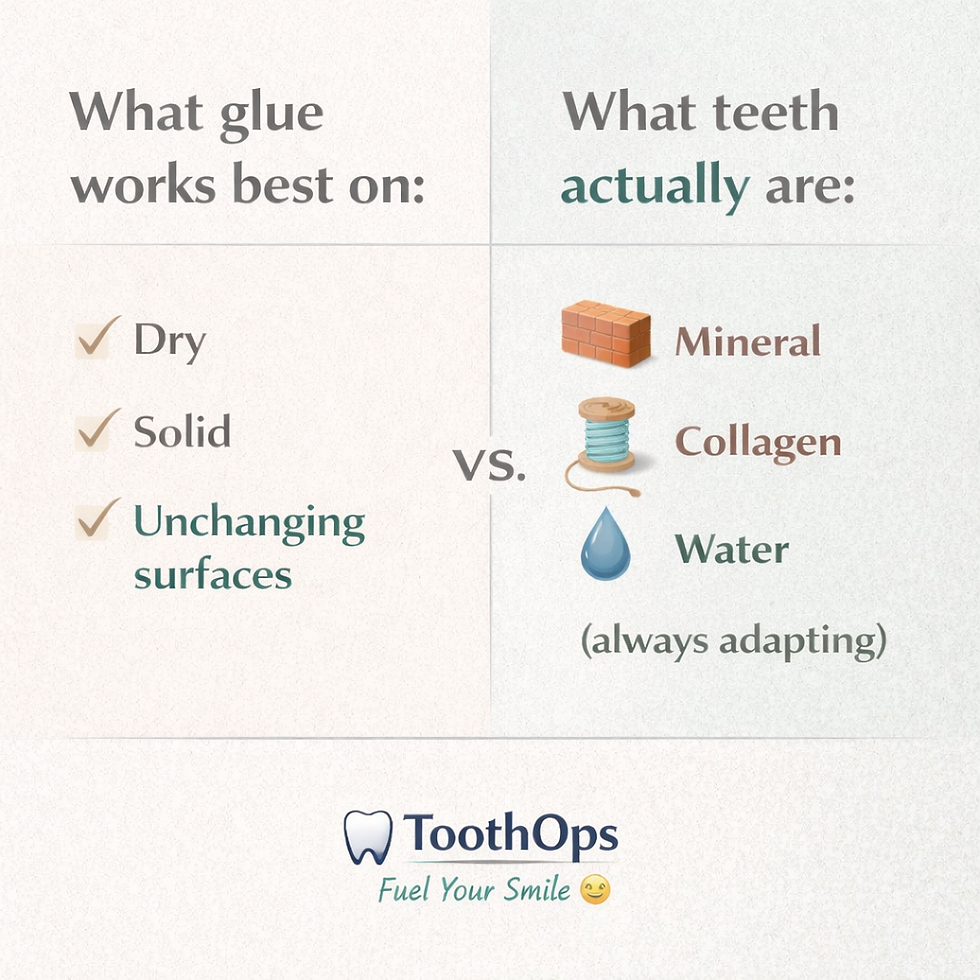
A tooth is not a dry, solid block 🧱
Beneath the enamel, tooth structure—especially dentin—is a hydrated composite tissue made of:
🧱 Mineral for strength
🧵 Collagen for flexibility
💧 Water for biologic function
Dentin also contains microscopic tubules that allow fluid movement. This means the surface a dental material meets is dynamic, not inert.
Bonding works by temporarily reshaping this surface:
🧪 Mineral is partially altered, increasing surface energy
🧵 Collagen is exposed and supported
🔗 Resin infiltrates microscopic spaces and then solidifies
This creates a hybrid interface—a zone where tooth structure and material interlock mechanically and stabilize chemically.
From a patient perspective, bonding is not about sticking onto the tooth, but about integrating with a living structure.
3️⃣ Why This Creates the Patterns We Notice
Once bonding is understood as an interface process, many patterns begin to make sense 💡
Moisture matters because collagen collapses when dehydrated
Surface conditions matter because permeability affects infiltration
Timing matters because biology and materials respond differently under stress
Simplification trades steps for convenience, but also reduces control
Importantly, bonding isn’t just about starting strong — it’s about how the interface holds up over time.
4️⃣ Why Incremental Layering Matters (Without Getting Technical)
When resin materials harden, they don’t just become solid — they shrink slightly as their internal structure forms. That shrinkage creates stress at the bonded interface.
Incremental layering — building restorations gradually rather than all at once — helps manage that stress.
From a systems perspective, smaller changes:
Introduce stress more gradually
Reduce strain at the bonded interface
Allow each layer to stabilize before additional forces are added
This reflects a broader principle seen across biology and engineering:
Interfaces last longer when change happens gradually, not abruptly.

5️⃣ Why Some Resin Restorations Last Longer Than Others
This is where patient experiences often diverge — and where understanding brings relief.
Restorations don’t all age the same because they exist within different systems.
Longevity is influenced by how well several factors align:
The quality of the initial interfaceA well-formed bond distributes stress evenly instead of concentrating it in one area.
Stress over timeChewing forces, temperature changes, and material fatigue slowly test the interface.
Biologic environmentTeeth respond to moisture, movement, and microscopic changes differently from one another.
How change was introducedGradual layering and thoughtful integration reduce overload at sensitive boundaries.
When restorations fail earlier than expected, it’s rarely due to a single mistake. More often, it reflects cumulative stress on a complex interface.
This is why two restorations placed years apart — or even side by side — can behave differently over time.
6️⃣ The Health Literacy Gap 🧩
Patients often hear:
“This filling should last.”
Students often hear:
“Just follow the system.”
Clinicians are thinking about:
interface durability
stress distribution
biologic variability
long-term material behavior
When those layers aren’t shared, variability can feel personal or arbitrary.
Understanding that restorations exist within living systems, not static ones, reframes expectations without blame or fear.

7️⃣ Why Dentistry Often Sees This Early
Dentistry works at boundaries:
🦷 Hard tissue meets soft tissue
💧 Controlled dryness meets fluid-rich biology
🔩 Mechanical forces meet living structures
Because dental materials must function in environments that are wet, load-bearing, and biologically active, dentistry often reveals interface challenges earlier than many other fields.
Concepts like incremental layering and interface management are dentistry’s way of respecting those realities.
8️⃣ What Clarity Changes 🌱
When people understand why restorations behave differently:
Anxiety decreases
Expectations become more realistic
Past experiences feel explainable, not personal
Dental care feels collaborative rather than mysterious
Understanding doesn’t promise permanence.It offers something more sustainable: context and agency.
9️⃣ ToothOps Takeaway ✨
Dental bonding is interface formation, not glue
Teeth are hydrated, biologic systems, not inert surfaces
Stress and time matter as much as strength
Incremental layering helps manage change gradually
Restoration longevity reflects systems alignment, not perfection
@ToothOps | Fuel Your Smile 😊
Stay tuned for more insights and educational content in our blog.
Disclaimer: Content is for educational purposes only and not a substitute for medical or dental care.© 2025 ToothOps | All Rights Reserved.


Comments