🫁 When TB Becomes Hard to Treat
- ToothOps

- Mar 4
- 3 min read
The Quiet Biology Behind Tuberculosis Drug Resistance
Most people think drug resistance happens when antibiotics are “used wrong.”
Tuberculosis is different.
TB doesn’t become drug-resistant because treatment exists —it becomes drug-resistant because survival makes resistance statistically inevitable.
This post explains why — calmly, clearly, and without fear.
🎯 Clinical Reasoning
Drug-resistant TB isn’t a mistake.It’s the predictable outcome of structure, mutation, and survival.

1️⃣ What Drug-Resistant TB Really Means (Beyond the Labels)
Drug-resistant TB is classified by which antibiotics no longer work:
RR-TB → rifampicin resistant
MDR-TB → resistant to isoniazid + rifampicin
Pre-XDR TB → MDR + fluoroquinolone resistance
XDR-TB → MDR + fluoroquinolone + key reserve drugs
As resistance accumulates:
Treatment duration increases
Toxicity rises
Outcomes worsen
📌 But classification tells you what failed — not why.

2️⃣ Why TB Is Different From Most Bacteria
🧠 Analogy Box
If most bacteria wear a jacket, TB wears a waxed raincoat and lives in a bunker.
TB’s cell wall is:
Lipid-rich
Hydrophobic
Reinforced with mycolic acids
Poorly permeable to many antibiotics
Mechanism → consequence → relevance
Mechanism: Thick, waxy barrier
Consequence: Low intracellular drug levels
Relevance: TB survives exposure that would kill other bacteria
This is intrinsic resistance — present before mutations occur.
3️⃣ The Most Important Insight (Most Students Miss This)
TB resistance often exists before treatment begins.
Why?
Because TB resistance arises from spontaneous chromosomal mutations, not gene sharing.
The more bacteria present:
The higher the chance mutations already exist
The more likely treatment selects resistant subpopulations
📌 High bacterial burden = higher resistance risk.
This is why:
Cavitary disease matters
Early combination therapy matters
Partial treatment is dangerous biologically — not morally
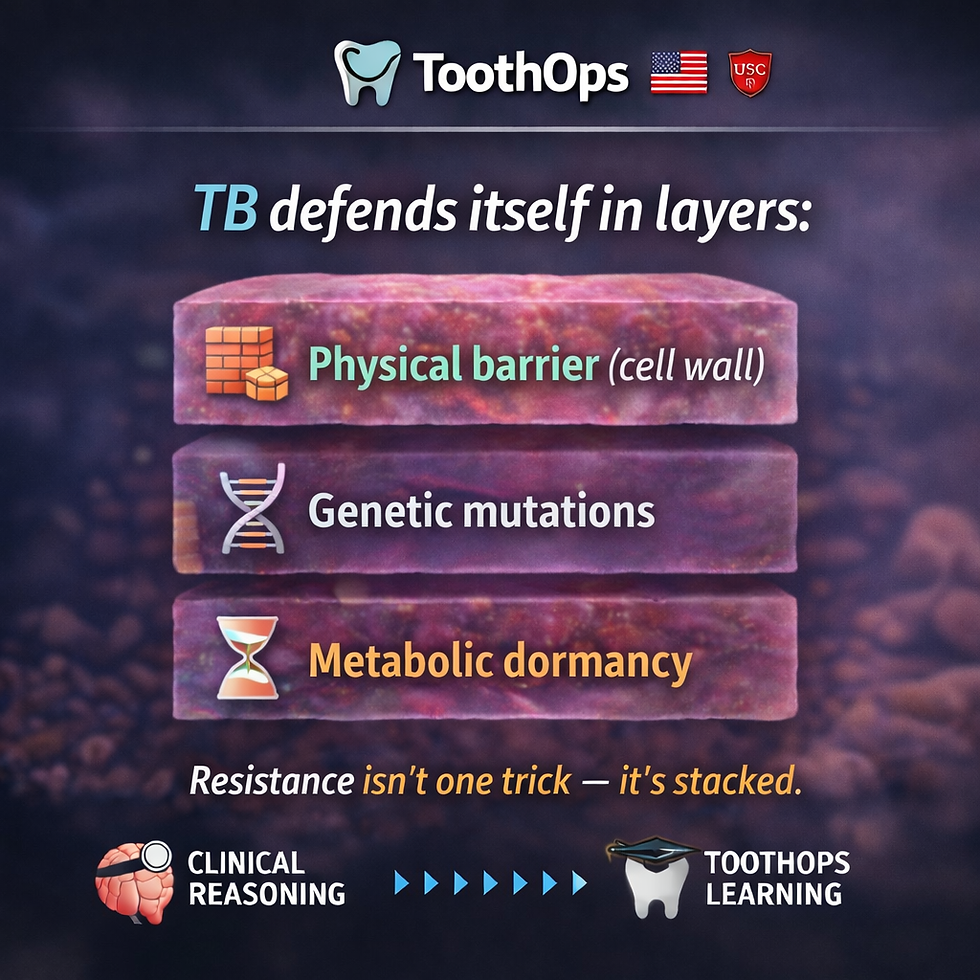
4️⃣ The Three Layers of TB Drug Resistance (Think in Systems)
🧩 Layer 1: Physical barriers
Waxy cell wall
Poor penetration
🧩 Layer 2: Genetic mutations
rpoB → rifampicin
katG / inhA → isoniazid
gyrA / gyrB → fluoroquinolones
These alter targets or block prodrug activation.
🧩 Layer 3: Metabolic state
Dormant or slow-growing bacteria
Reduced susceptibility to many drugs
💡 Resistance isn’t one trick — it’s a stacked defense.
5️⃣ Efflux Pumps: Time Is the Enemy
TB also uses efflux pumps to push drugs out.
Efflux alone may not cause resistance — but it:
Buys time
Lowers effective drug concentration
Allows mutations to accumulate
🧠 Efflux turns survival into opportunity.

📊 Clinical Reasoning Snapshot
Resistance Factor | What It Does | Why It Matters |
Waxy cell wall | Limits entry | Intrinsic tolerance |
Point mutations | Alter targets | True resistance |
Efflux pumps | Expel drugs | Mutation window |
Dormancy | Low metabolism | Drug tolerance |
Cavitation | Poor penetration | Selection pressure |
6️⃣ Why Multidrug Therapy Works (And Monotherapy Fails)
No single drug can overcome:
Barriers
Mutations
Dormancy
Efflux
Combination therapy works because it:
Hits multiple pathways
Targets active + inactive populations
Prevents one mutation from guaranteeing survival
💡 This is why isoniazid is never given alone.
7️⃣ Adherence Is Biology, Not Blame
Missed doses don’t “create” resistance.They select organisms already capable of surviving.
Directly observed therapy matters because it:
Prevents subtherapeutic exposure
Reduces selective pressure
Protects future treatment options
This is evolutionary math, not personal failure.

8️⃣ Where TB Treatment Is Heading
Modern strategies now include:
Host-directed therapy
Drug repurposing (e.g., metformin, statins)
Improved drug delivery systems
Targeting bacterial persistence mechanisms
The goal isn’t just killing TB —it’s preventing survival long enough to adapt.
🌱 Final ToothOps Takeaway
Drug-resistant TB isn’t mysterious.It’s the outcome of structure, survival, and selection.
When you understand that, treatment stops feeling arbitrary —and clinical reasoning becomes calm, confident, and precise.
@ToothOps | Fuel Your Smile 😊Stay tuned for more insights and educational content in our blog.
Disclaimer: Content is for educational purposes only and not a substitute for medical or dental care.
© 2025 ToothOps | All Rights Reserved.


Comments