🌍 Pandemic vs Epidemic vs Endemic
- ToothOps

- May 27
- 4 min read
Understanding How Infectious Diseases Spread Through Populations
During the COVID-19 crisis, the word pandemic became part of everyday conversation.
However, in epidemiology, several specific terms describe how diseases spread through populations.
These terms — endemic, epidemic, outbreak, and pandemic — are not interchangeable.
Each represents a different pattern of disease transmission and helps public health professionals understand the scale of an infectious threat.
Understanding these distinctions helps explain why some infections remain localized while others spread across the world.

❓ Start With One Question
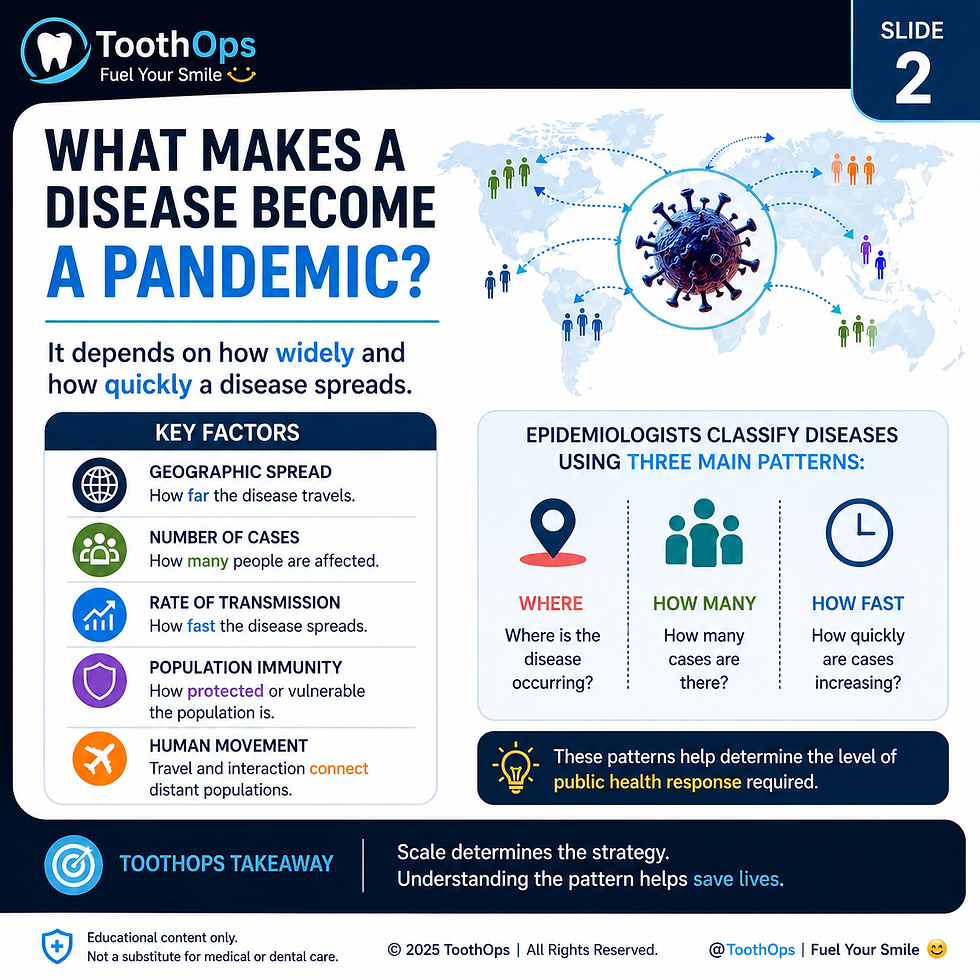
What determines whether a disease becomes a pandemic?
The answer depends on how widely and rapidly a disease spreads within human populations.
Epidemiologists classify infectious diseases based on:
geographic distribution
number of cases within a population
rate of transmission
These patterns help determine the level of public health response required.
🦠 Endemic Diseases: The Baseline Level
A disease is considered endemic when it is consistently present within a specific geographic region or population.
This does not mean the disease is harmless. Instead, it means the infection occurs at a relatively predictable baseline level over time.
Examples include:
Disease | Where It Is Endemic |
Malaria | Tropical regions of Africa and South Asia |
Dengue fever | Southeast Asia and Latin America |
Seasonal influenza | Many regions worldwide |
In endemic conditions, infections occur regularly but generally remain within expected levels.

📈 Epidemics: When Cases Rise Above Normal
An epidemic occurs when the number of disease cases increases above the expected baseline within a particular region.
This increase may occur within:
a city
a country
a defined population group
Epidemics often occur when a pathogen spreads rapidly through individuals who have limited immunity.
Examples include:
Epidemic | Location |
Ebola outbreaks | West Africa |
Cholera epidemics | Areas with limited clean water access |
Measles outbreaks | Communities with low vaccination rates |

🏫 Outbreaks: Localized Transmission
An outbreak is essentially a localized epidemic.
The term is commonly used when disease transmission occurs in a smaller or more contained population, such as:
a school
a hospital
a workplace
a community setting
Public health authorities often investigate outbreaks quickly to prevent wider spread.

🌎 Pandemics: Global Disease Spread
A pandemic occurs when an epidemic spreads across multiple countries or continents, affecting large numbers of people.
Three major factors usually allow a pandemic to occur:
🌍 the pathogen spreads efficiently between humans
🌍 the population has little or no preexisting immunity
🌍 global travel enables rapid international transmission
Historical examples include:
Pandemic | Approximate Time Period |
1918 Influenza Pandemic | 1918–1920 |
H1N1 Influenza Pandemic | 2009 |
COVID-19 Pandemic | 2019–2023 |
Pandemics represent the largest scale of infectious disease spread.

🧬 Why Influenza Viruses Can Cause Pandemics
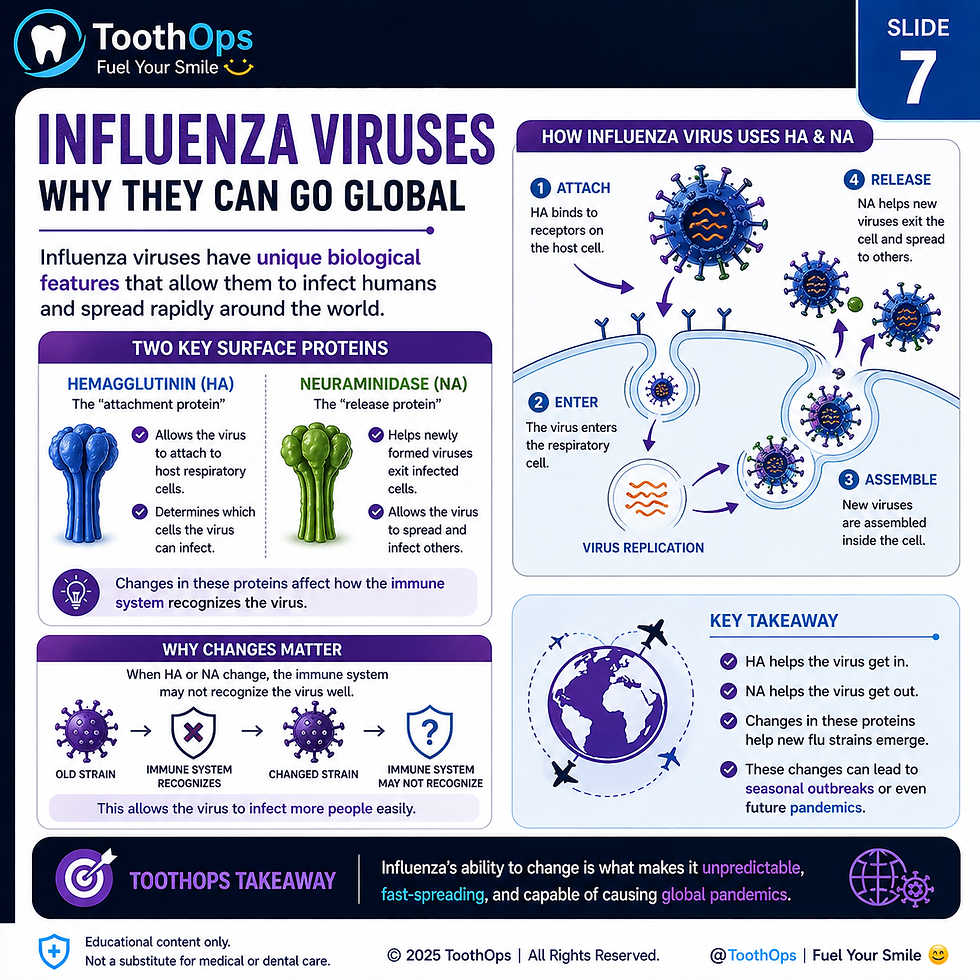
Influenza viruses have biological characteristics that make global spread possible.
Two viral surface proteins are particularly important:
Viral Protein | Function |
Hemagglutinin (HA) | Allows the virus to attach to host respiratory cells |
Neuraminidase (NA) | Allows newly formed viruses to exit infected cells |
Changes in these proteins affect how the immune system recognizes the virus.
🔬 Antigenic Drift vs Antigenic Shift
Influenza viruses evolve through two major mechanisms.
Mechanism | What Happens | Public Health Impact |
Antigenic Drift | Small mutations accumulate over time | Seasonal influenza outbreaks |
Antigenic Shift | Major genetic reassortment between strains | Potential influenza pandemics |
Antigenic shift occurs primarily in Influenza A viruses, which infect multiple species including birds, pigs, and humans.
When genetic segments mix between viral strains, a new influenza subtype can emerge that human immune systems have not previously encountered.
This lack of immunity allows rapid spread.

🌬 How Respiratory Viruses Spread
Respiratory viruses commonly spread through:
respiratory droplets produced during coughing or sneezing
direct contact with contaminated surfaces
aerosol transmission in enclosed environments
Once inside the airway, viruses infect respiratory epithelial cells and begin replicating.
This replication can damage the airway lining and weaken the respiratory system’s normal defenses.

🛡 Practical Prevention Strategies
Although pandemics involve complex biological and societal factors, several preventive measures help reduce transmission.
💉 VaccinationStimulates immune protection before exposure.
🧼 Hand hygieneReduces transmission through contaminated surfaces.
🏥 Healthcare infection controlProtects vulnerable patients.
🌍 Disease surveillance systemsAllow scientists to detect emerging pathogens early.
These strategies are essential for limiting the spread of infectious diseases.

📚 Exam Insight
Understanding epidemiologic terminology is a common topic in medical and dental examinations.
Term | Definition |
Endemic | Constant presence of a disease within a geographic region |
Hyperendemic | Persistently high disease levels within a population |
Epidemic | Increase in disease cases above the expected baseline |
Outbreak | Localized epidemic affecting a smaller population |
Pandemic | Epidemic spreading across multiple countries or continents |
Key Viral Comparison
Virus | Virus Family | Genome |
Influenza virus | Orthomyxoviridae | Segmented negative-sense RNA |
Rhinovirus (common cold) | Picornaviridae | Positive-sense RNA |
🧠 Memory Anchor
Endemic → Epidemic → Pandemic(increasing geographic spread)
🧠 The Bigger Picture
Infectious diseases rarely spread randomly. They follow identifiable biological and epidemiologic patterns.
Understanding these patterns allows scientists to detect emerging threats, helps clinicians recognize complications earlier, and enables communities to respond more effectively.
Public health, medicine, and prevention all rely on a simple principle:
the better we understand disease patterns, the better we can protect population health.
@ToothOps | Fuel Your Smile 😊
Understanding the science behind disease spread helps us make better decisions about prevention, health, and community safety.
Stay tuned for more insights and educational content in our blog.
Disclaimer: Content is for educational purposes only and not a substitute for medical or dental care.
© 2025 ToothOps | All Rights Reserved.


Comments