🩸 How the Body Stops Bleeding: The Hidden Biology Behind Everyday Injuries

Bleeding is something most of us encounter in small ways—a nick while flossing, a cut while cooking, or bleeding gums during brushing.
What’s remarkable is how quickly the body usually stops the bleeding.
Within seconds, a complex biological system activates to prevent blood loss and protect the body.
This process is called hemostasis, and it involves a carefully coordinated sequence of events between blood vessels, platelets, and clotting proteins.
Understanding this process reveals how the body protects itself—and why bleeding patterns sometimes tell us important biological information.
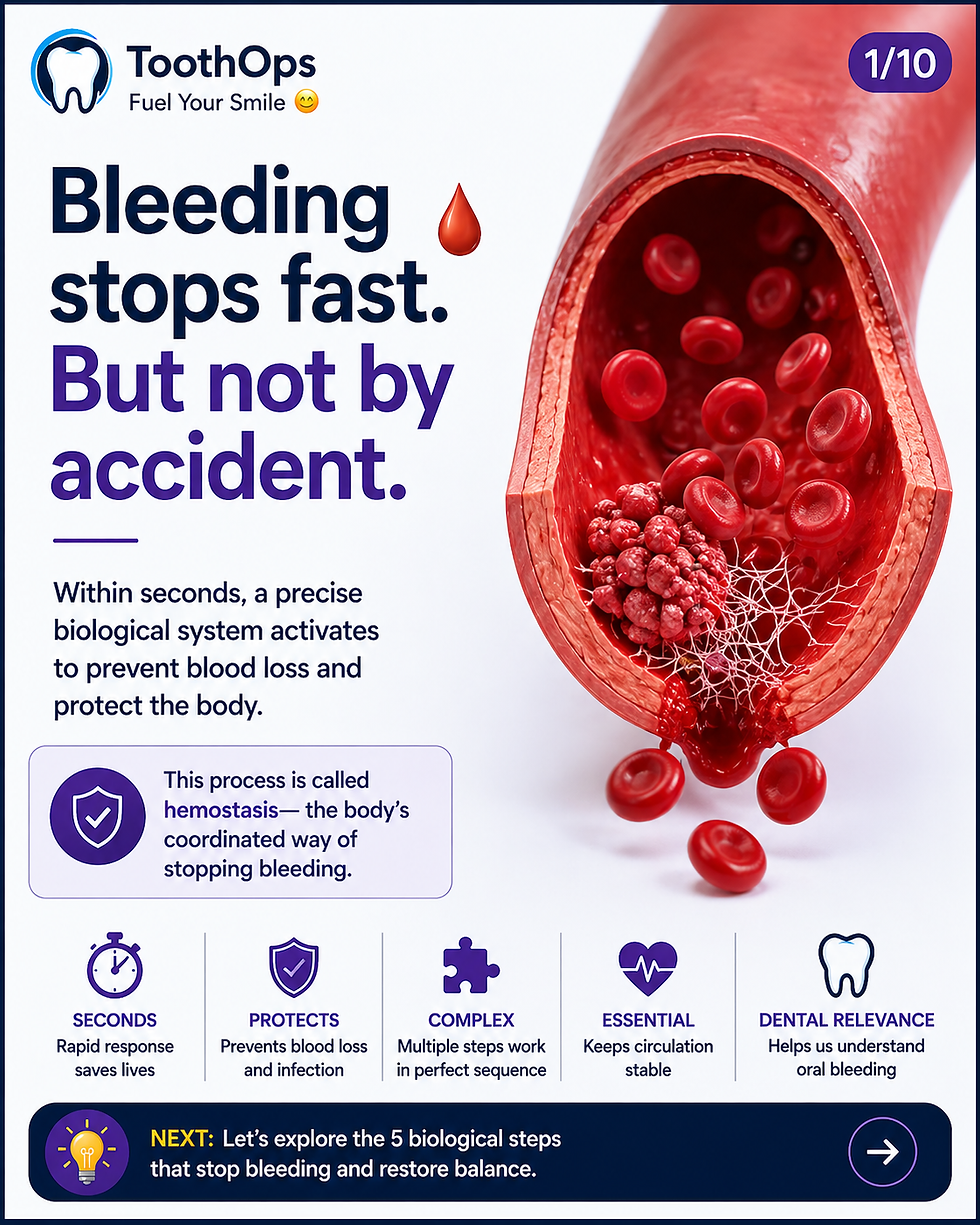
🧬 The Underlying Biology: Hemostasis
Hemostasis literally means “stopping blood.”
Rather than being a single event, it occurs through five coordinated steps that stabilize damaged blood vessels and restore normal circulation.
🧩 The Five Biological Steps
1️⃣ Vessel Spasm
2️⃣ Platelet Plug Formation
3️⃣ Blood Coagulation
4️⃣ Clot Retraction
5️⃣ Clot Dissolution (Fibrinolysis)
Each stage builds upon the previous one.
Think of it as the body building, strengthening, and eventually removing a temporary repair patch.

🚧 Step 1 — Vessel Spasm (Immediate Protection)
The first response happens within seconds.
When a blood vessel is injured:
🧬 Smooth muscle in the vessel wall contracts
🩸 The vessel narrows (vasoconstriction)
🔬 Blood flow to the injured area temporarily decreases
This reflexive contraction helps reduce blood loss while the next steps begin.
This phase is brief—usually lasting less than one minute—but it buys the body valuable time.

🧱 Step 2 — Platelet Plug Formation
Platelets are small fragments of cells that circulate in the bloodstream.
Their main role is rapid damage control.
🔬 What platelets do
When a vessel wall is damaged:
🧩 Platelets adhere to exposed collagen fibers in the injured vessel wall.
This adhesion requires an important protein called:
🧬 Von Willebrand Factor (vWF)
This protein acts like molecular glue, helping platelets attach to damaged tissue.
🧪 Platelet Activation
Once platelets attach to the injury site, they become activated and release signaling molecules such as:
ADP
thromboxane A₂
serotonin
calcium ions
These molecules recruit additional platelets to the area.
Soon, platelets begin sticking to each other, forming a temporary plug that slows bleeding.


🧬 Step 3 — Blood Coagulation (Building the Clot)
While platelets form the initial plug, the body simultaneously activates a deeper biochemical system known as the coagulation cascade.
This cascade converts a soluble protein in blood called fibrinogen into fibrin, an insoluble protein that forms strong threads.
These fibrin strands weave through the platelet plug, reinforcing it into a more stable clot.
🧪 Two pathways initiate coagulation
Extrinsic pathway
triggered by tissue injury outside the blood vessel
begins with tissue factor (Factor III)
Intrinsic pathway
activated when blood contacts exposed collagen in damaged vessels
involves clotting factors such as Factor XII, XI, IX, and VIII
Both pathways converge into the common pathway, where:
🧬 Prothrombin → Thrombin
🧬 Fibrinogen → Fibrin
This step transforms the platelet plug into a reinforced fibrin clot.

🧷 Step 4 — Clot Retraction (Strengthening the Repair)
Once fibrin fibers form, platelets begin to contract.
This contraction pulls the fibrin threads tighter, which:
🧱 stabilizes the clot
🔧 pulls the edges of the damaged vessel closer together
Clot retraction helps create a firm structure that allows the vessel wall to begin healing.
This stage requires adequate platelet numbers, which is why platelet deficiencies can impair clot stability.

🌊 Step 5 — Clot Dissolution (Returning to Normal)
Once the vessel is repaired, the body removes the clot.
This process is called fibrinolysis.
A protein called plasmin gradually breaks down fibrin fibers, dissolving the clot and restoring normal blood flow.
In other words:
🧠 The body builds a clot when needed
🌿 and removes it once healing is complete

🦷 Where Dentistry Encounters This System
The mouth is highly vascular, meaning it contains many small blood vessels.
Because of this, dental professionals regularly observe how well the hemostatic system functions.
Examples include:
🪥 bleeding during brushing or flossing
🦷 bleeding during dental cleanings
🩹 healing after dental procedures
🧬 responses to medications affecting clotting
These observations can provide insight into how the body’s clotting system is functioning overall.
📚 The Health Literacy Gap
Many people interpret bleeding in ways that may not reflect the underlying biology.
Common assumptions include:
❌ “Bleeding means something is seriously wrong.”
❌ “Bleeding means I should stop brushing or flossing.”
In reality, bleeding can occur when the body is actively responding to local inflammation or tissue disruption.
Understanding the biology behind bleeding helps people approach these situations with curiosity rather than fear.
🌿 What Understanding Changes
When people understand hemostasis, several things become clearer:
✔ why the body usually stops bleeding quickly
✔ how platelets and clotting proteins work together
✔ why inflammation can increase bleeding in oral tissues
✔ why dental professionals pay attention to bleeding patterns
These insights help transform everyday observations into meaningful biological understanding.
🪥 ToothOps Takeaway
🧬 Hemostasis is the body’s coordinated system for stopping bleeding.
🩸 The process involves five stages: vessel spasm, platelet plug formation, coagulation, clot retraction, and fibrinolysis.
🧱 Platelets provide rapid damage control while fibrin creates a stronger, more stable clot.
🔬 Multiple clotting pathways work together to reinforce injured blood vessels.
🌿 Once healing occurs, the body dissolves the clot to restore normal circulation.

💭 Reflection Question
The next time you notice a small cut or bleeding while brushing, consider:
What biological systems are quietly working in that moment to restore balance?
Understanding these processes often reveals how remarkably coordinated the human body truly is.
@ToothOps | Fuel Your Smile 😊
Stay tuned for more insights and educational content in our blog.
Disclaimer: Content is for educational purposes only and not a substitute for medical or dental care.
© 2025 ToothOps | All Rights Reserved.


Comments