How a Small Cavity Can Turn Into Facial Swelling 🦷

By ToothOps

Most cavities start small.
A tiny area of tooth decay may take months—or even years—to become noticeable. Because early cavities often cause little or no pain, many people delay treatment.
Unfortunately, a cavity does not always stay confined to the tooth.
Left untreated, a small cavity can eventually progress into a serious infection capable of causing facial swelling, severe pain, and even hospitalization.

Stage 1: A Cavity Forms
The process begins when bacteria in dental plaque produce acids that dissolve enamel.
Initially, the damage is limited to the outer layer of the tooth. At this stage, treatment is usually simple and may involve a small filling.
Stage 2: The Infection Reaches the Nerve ⚡
As decay progresses deeper into the tooth, bacteria eventually reach the pulp—the living center of the tooth that contains nerves and blood vessels.
Inflammation develops and pressure begins to build.
Patients may notice:
Sensitivity to hot and cold
Lingering pain
Pain when chewing
Without treatment, the pulp can die.
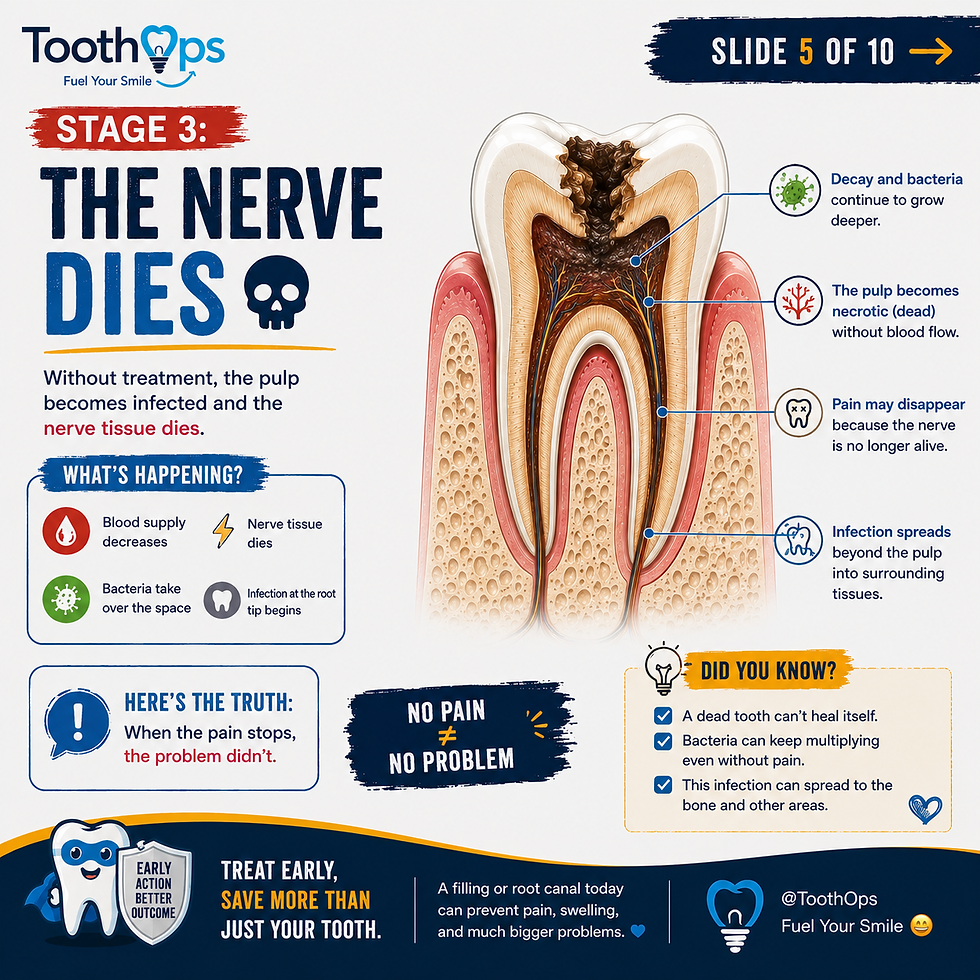
Stage 3: Infection Leaves the Tooth 🦠
Once the pulp becomes infected or necrotic, bacteria can travel through the root tip and enter the surrounding bone.
An infection develops around the root.
At this stage, patients often experience:
Constant pain
Swelling of the gums
Tenderness when biting
Stage 4: The Infection Breaks Through Bone ⚠️
As infection progresses, bacteria destroy bone and eventually break through the cortical plate.
Once outside the bone, infection enters the surrounding soft tissues.
This is often when patients first notice visible facial swelling.

Stage 5: An Abscess Forms 💥
The body's immune system attempts to contain the infection.
White blood cells accumulate and fight invading bacteria. Over time, dead bacteria, dead immune cells, and tissue debris form pus.
This creates an abscess.
At this point, treatment frequently requires:
Root canal therapy
Tooth extraction
Incision and drainage
Antibiotics when indicated

Stage 6: The Infection Can Spread 🚨
Severe infections may spread into deeper tissues of the head and neck.
Potential complications include:
Deep neck infections
Difficulty swallowing
Difficulty breathing
Airway compromise
Hospitalization
The Good News ✅
Every stage before this point offers an opportunity for intervention.
A filling is easier than a root canal.
A root canal is easier than an extraction.
An extraction is easier than treatment of a facial space infection.
The earlier treatment occurs, the simpler the solution usually becomes.

@ToothOps | Fuel Your Smile 😊
Stay tuned for more insights and educational content in our blog.
Disclaimer: Content is for educational purposes only and is not intended to diagnose, treat, cure, or replace professional medical or dental advice. Always consult a qualified healthcare professional regarding any medical or dental concerns.
© 2025 ToothOps | All Rights Reserved.



Comments