Aphasia, Apraxia, Agnosia, and Dysarthria

Understanding the Brain Behind Communication and Oral Care
After a stroke or other brain injury, a patient may have trouble speaking, following instructions, recognizing objects, or performing familiar tasks such as brushing their teeth.
At first glance, these problems can look similar.
They are not.
A patient who cannot understand what you are saying, a patient who knows what they want to say but cannot get the words out, and a patient who understands perfectly but cannot organize the movements needed to use a toothbrushare experiencing failures in different parts of the nervous system.
Understanding those differences helps make neuroanatomy much easier—and it also changes how we communicate with and care for patients.

Start With the Big Picture 🧠
A simple task such as brushing your teeth actually requires several brain functions to work in sequence:
See the toothbrush
↓
Recognize what it is
↓
Understand what you are being asked to do
↓
Plan the learned movement
↓
Send motor commands to the muscles
↓
Perform the movement
A problem can occur at any step.
That gives us a useful framework:
If the patient has trouble with... | Think about... |
Understanding or producing language | Aphasia |
Recognizing an object despite seeing it | Agnosia |
Planning a learned movement | Apraxia |
Physically executing the movement | Weakness/paralysis/ataxia |
Producing clear speech with intact language | Dysarthria |
The terms sound similar, but the mechanisms are very different.

1. Aphasia = A Problem With Language
Aphasia is an acquired impairment of language caused by injury to language networks in the brain.
It can interfere with:
speaking,
understanding speech,
reading,
writing,
naming objects,
or combinations of these.
Importantly:
Aphasia does not automatically mean that the patient has lost intelligence.
The patient may know exactly what they want to communicate but have difficulty converting that thought into language—or interpreting language coming from someone else.
Broca-Type Aphasia: The Thought Is There, but Speech Is Hard
Broca-type aphasia is classically associated with damage to the dominant frontal language network, especially the inferior frontal region.
The patient usually has relatively preserved comprehension but produces:
slow speech,
short phrases,
effortful speech,
missing grammatical words.
For example, instead of saying:
“The lower right tooth started hurting yesterday.”
the patient might say:
“Tooth… right… hurt… yesterday.”
The important point is that the patient may understand much more than their speech makes it appear.
Easy way to remember it
Broca → production problem
The language is in the brain, but getting it out is difficult.
Wernicke-Type Aphasia: Speech Flows, but Meaning Is Disrupted
Wernicke-type aphasia is classically associated with the dominant posterior temporal language network.
The patient may speak fluently and produce normal-sounding sentences, but:
comprehension is poor,
words may be substituted,
sentences may not make sense,
the patient may not realize that communication is impaired.
The key difference:
Broca-type pattern:“I understand you, but I struggle to speak.”
Wernicke-type pattern:“I can speak fluently, but language comprehension and meaning are impaired.”
What About “I Know It, but I Can’t Remember the Word”?
That may represent anomia, or impaired word retrieval.
You show the patient a toothbrush.
They may say:
“I know what that is. You use it for… your teeth… but I can’t remember what it’s called.”
They recognize the object.
They understand its purpose.
The missing step is retrieving its name.
That is different from not recognizing the toothbrush at all.
2. Agnosia = The Brain Receives the Information but Cannot Recognize It
Agnosia is impaired recognition despite relatively intact basic sensation.
For example, a patient may have functioning vision and clearly see a toothbrush but fail to identify what the object is.
Think of visual processing as two levels:
Eyes receive the image↓Visual cortex processes the image↓Association networks assign meaning to the image
Agnosia affects that higher-level recognition process.
Anomia vs Agnosia
This distinction is useful:
Patient response to a toothbrush | Likely problem |
“I know what it is and how to use it, but I can't remember its name.” | Anomia |
“I can see it, but I don't know what that object is.” | Agnosia |
The first is mainly a language retrieval problem.
The second is a recognition problem.
The Occipital Lobe: Seeing Is More Than Just Having Working Eyes
The occipital lobe is the major cortical region involved in vision.
A lesion there can produce:
visual-field defects,
impaired visual processing,
abnormal color perception,
visual hallucinations,
or cortical blindness depending on the area involved.
But recognizing what you see requires more than the primary visual cortex.
Visual information travels into association pathways.
One major pathway travels toward the temporal lobe and helps answer:
“What am I looking at?”
That is why disorders of recognition can involve networks extending beyond the occipital cortex itself.
3. Apraxia = The Patient Understands the Task but Cannot Organize the Movement
This is especially important in rehabilitation.
Apraxia is difficulty performing a learned purposeful movement even though the patient:
understands the command,
has enough strength to perform it,
and is not simply paralyzed.
Imagine asking:
“Show me how you brush your teeth.”
The patient recognizes the toothbrush.
They understand your instruction.
They can raise their arm.
But they cannot correctly organize the brushing movement.
That points toward a problem with motor planning, not muscle strength.
Why Can Someone Move Their Arm but Still Not Know How to Brush?
A learned movement requires several steps:
Goal: brush teeth
↓
Retrieve the learned motor program
↓
Sequence the movements↓Position the arm and hand
↓
Coordinate repeated brushing strokes
↓
Adjust movement using sensory feedback
Apraxia interrupts the planning or organization of that sequence.
The muscles may still be capable of contracting.
The problem is that the brain cannot properly convert the idea of the action into an organized motor program.
A Useful Distinction
Weakness
“I know how to brush, but my arm is too weak.”
Apraxia
“My arm can move, but I cannot correctly organize the brushing task.”
Those require completely different rehabilitation strategies.
4. Dysarthria = Language Is Intact, but Speech Execution Is Impaired
Another common source of confusion is dysarthria.
A person with dysarthria can:
understand language,
choose the correct words,
form the sentence mentally,
but the muscles used for speech do not execute the motor commands normally.
Speech may sound:
slurred,
slow,
weak,
strained,
or poorly articulated.
So:
Aphasia = language problem
Dysarthria = motor speech problem
Why This Matters After Stroke
A stroke can affect several of these systems at once.
A patient might have:
aphasia + facial weakness + dysarthria + apraxia
That is why simply describing someone as having “difficulty speaking” tells us very little.
We need to ask:
Can they understand language?
Can they formulate language?
Can they plan the movement?
Can the muscles physically perform it?
Those questions localize the problem much more effectively.
A Simple Brain Map
The brain works as an interconnected network, so real injuries do not always fit perfectly into one box. Still, these associations are useful:
Region/network | Important functions |
Dominant frontal language network | Speech production |
Dominant posterior temporal network | Language comprehension |
Medial temporal structures / hippocampus | Memory formation |
Parietal association cortex | Spatial processing, sensory integration, praxis |
Premotor networks | Planning learned movements |
Occipital cortex | Visual processing |
Motor cortex/corticospinal pathways | Movement execution |
Easy memory:
Frontal → DO
Parietal → WHERE + HOW
Temporal → UNDERSTAND + REMEMBER
Occipital → SEE
It is simplified—but useful as a starting map.
Memory and the Temporal Lobe
The temporal lobe is especially important when a patient has both language and memory problems.
The medial temporal lobe contains the hippocampus, which is essential for forming new declarative memories.
Damage to this system may make it difficult for a patient to form new memories even if older memories remain available.
So when a patient develops:
difficulty remembering recent events,
difficulty learning new information,
impaired language comprehension,
the temporal region becomes particularly important to consider.
What Is Apraxia Actually Like for the Patient?
Consider something as familiar as oral hygiene.
A person may have brushed their teeth twice a day for decades.
recognize the bathroom,
recognize the toothbrush,
know that teeth need cleaning,
understand your instruction,
move their arm normally,
yet struggle to organize the brushing sequence.
The problem is not that they forgot why teeth need brushing.
The problem is accessing and executing the learned motor program.

Why Dentistry Makes These Differences Easy to See 🦷
Dental care involves unusually complex combinations of:
language,
facial movement,
swallowing,
sensation,
fine motor control,
memory,
learned movement,
and decision-making.
That means neurological deficits may become very obvious during oral care.
Example 1: Food Collecting in the Cheek
After a stroke, facial weakness can reduce buccinator function.
Normally the buccinator helps keep food positioned between the teeth during chewing.
If the cheek is weak:
↓
buccinator control→ food collects in vestibule→ patient may not clear it effectively→ prolonged food contact around teeth→ increased plaque/caries risk
The patient may need to be taught to check the affected side of the mouth after eating.
Example 2: Patient Cannot Brush Effectively
Several mechanisms are possible:
Hand weakness→ cannot physically manipulate toothbrush.
Apraxia→ cannot organize brushing sequence.
Visual-field loss→ repeatedly misses one side.
Cognitive impairment→ forgets whether brushing occurred.
Aphasia→ cannot understand complicated hygiene instructions.
Each requires a different solution.

The Difference Between Hemianopia and Neglect
This is another useful distinction after stroke.
Hemianopia
Part of the visual field is physically missing because of damage somewhere along the visual pathway.
The patient may genuinely not see objects on one side.
Hemispatial neglect
The patient may have functioning visual pathways but fails to attend to one side of space.
For oral hygiene, both can lead to one side being repeatedly missed—but for different reasons.
A patient may:
clean only one half of the dentition,
miss food on one side of the plate,
bump into objects,
or repeatedly overlook items placed in the affected visual field.
That is why occupational therapy often teaches systematic visual scanning.
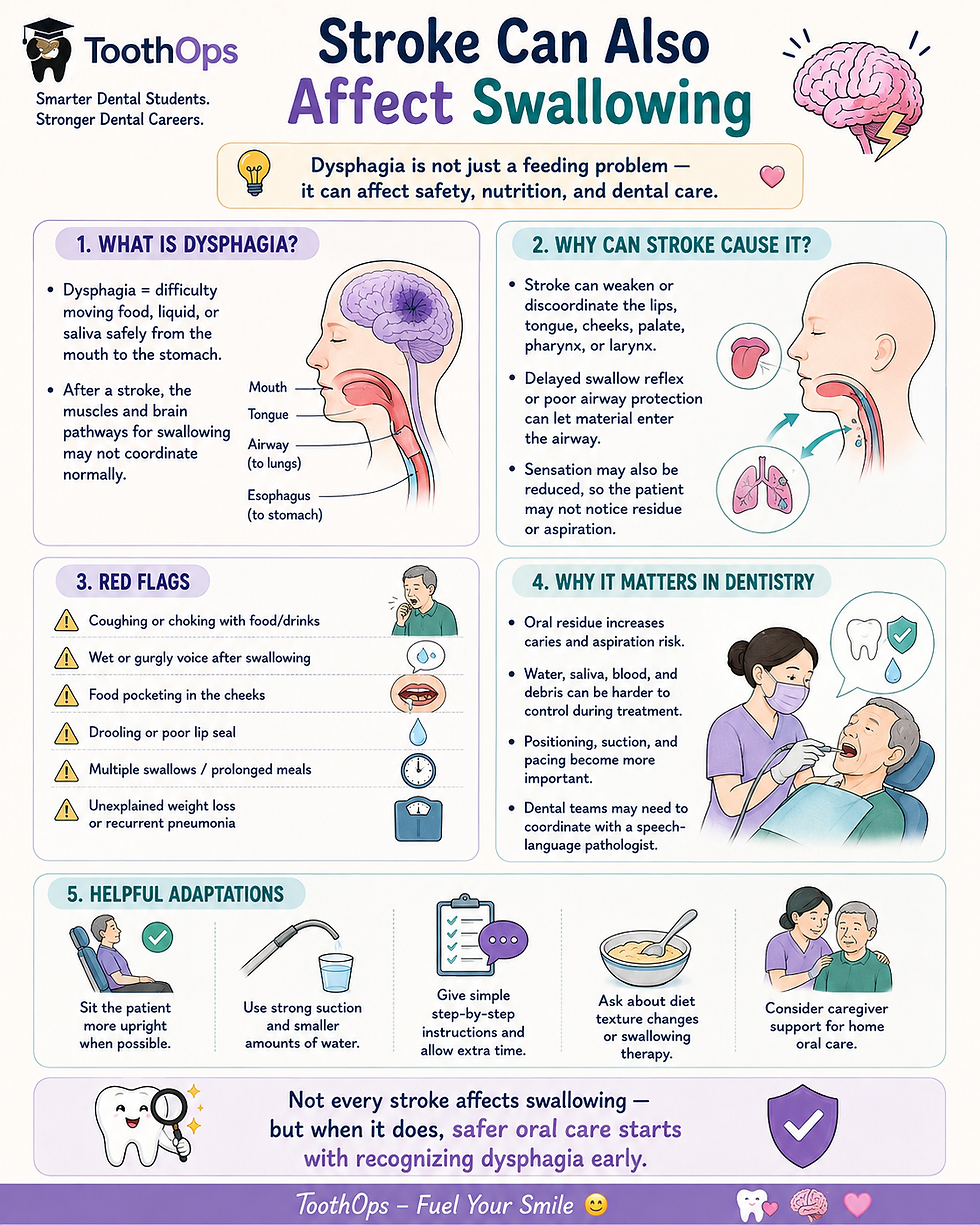
Stroke Can Also Affect Swallowing
Language is not the only concern.
A stroke may also produce dysphagia, or impaired swallowing.
Normal swallowing requires coordinated activity between:
cortical swallowing networks,
brainstem centers,
cranial nerves,
tongue,
pharyngeal muscles,
larynx.
If coordination is disrupted:
poor bolus control→ food or liquid enters pharynx incorrectly→ airway protection may fail→ aspiration
Some patients may aspirate without a strong cough response, called silent aspiration.
This is one reason speech-language pathologists are frequently involved in stroke rehabilitation.
They do much more than “speech.”
They may assess:
language,
articulation,
cognition,
and swallowing.
Communication and Dental Consent
Aphasia creates another important clinical issue.
A patient may struggle to verbally explain a decision without necessarily lacking the ability to
make one.
These are not equivalent:
Communication impairment
versus
Decision-making incapacity
For example, a patient may understand:
“This tooth cannot be predictably restored. We can remove it today or postpone treatment.”
but be unable to produce a fluent verbal response.
Communication can be supported using:
short sentences,
written keywords,
pictures,
radiographs,
pointing,
gestures,
yes/no choices,
demonstration,
extra response time.
The goal is to reduce the communication barrier before deciding what the patient does or does not understand.
A Better Way to Give Instructions
Instead of giving several steps at once:
“Brush twice daily with fluoride toothpaste using small circular motions along the gingival
margin, then clean interproximally.”
Try breaking it down:
“Put toothpaste on the brush.”
Pause.
“Start on the upper right.”
Demonstrate.
“Brush along the gumline.”
Demonstrate again.
For some patients, a picture sequence may work better than verbal instructions.

Why Repetition Can Help After Stroke
The nervous system has some capacity for neuroplasticity.
Neuroplasticity means that surviving neural networks can change their connections and
organization in response to experience and repeated activity.
After injury:
repeated task→ repeated activation of surviving pathways→ synaptic strengthening + network reorganization→ improved performance
This does not mean that dead neurons simply grow back.
It means the remaining nervous system can sometimes learn to perform a task more efficiently
or recruit alternative pathways.
That is why rehabilitation often involves repeating functional tasks again and again.
Walking.
Speaking.
Reaching.
Eating.
Brushing.
The repetition itself is part of the therapy.
Who Helps With What?
Recovery after neurological injury is often multidisciplinary.
Specialist | Main role |
Neurologist | Stroke localization, neurologic deficits, secondary prevention |
Speech-language pathologist | Aphasia, dysarthria, cognition, swallowing |
Occupational therapist | Daily activities, apraxia, visual compensation, adaptive tools |
Physical therapist | Walking, balance, strength, mobility |
Neuropsychologist | Memory, attention, executive function, cognitive testing |
Dentist/dental hygienist | Oral disease prevention, adapted hygiene, dental treatment planning |
Caregiver/family | Daily reinforcement and assistance |
The best result often comes from understanding that oral health is part of the patient's overall rehabilitation rather than a separate problem.
Putting Everything Together
Imagine four patients are each handed a toothbrush.
Patient A
They recognize the toothbrush and understand you but cannot say its name.
→ Language retrieval problem / anomia
Patient B
They see the toothbrush but cannot recognize what it is.
→ Agnosia
Patient C
They recognize it, understand its purpose, and have good strength—but cannot organize the brushing motion.
→ Apraxia
Patient D
They understand everything and know exactly how to brush, but the hand is too weak to perform the movement.
→ Motor impairment
The outward result may look similar:
The patient does not brush effectively.
But the neurological reason—and therefore the treatment—is completely different.
High-Yield Comparison
Disorder | What is actually impaired? | Simple example |
Aphasia | Language | Cannot understand/name/explain |
Anomia | Word retrieval | Knows toothbrush but cannot name it |
Agnosia | Recognition | Sees toothbrush but cannot identify it |
Apraxia | Learned motor planning | Knows what brushing is but cannot organize it |
Dysarthria | Speech motor execution | Knows words but speech is slurred |
Hemiparesis | Strength/motor output | Knows how to brush but arm is weak |
Hemianopia | Visual field | Cannot see part of the environment |
Dysphagia | Swallowing | Difficulty safely moving food/liquid |
What Dental Professionals Can Take From This
When oral hygiene deteriorates after a stroke, asking the patient to “brush better” may not address the actual problem.
Work backward:
Can they see the area?
Can they recognize the tool?
Can they understand the instruction?
Can they remember the task?
Can they plan the movement?
Can they physically perform it?
Can they safely swallow?
Once you know where the problem occurs, the intervention becomes more specific.
The patient may need:
a powered toothbrush,
a larger handle,
visual cues,
one-step instructions,
caregiver assistance,
occupational therapy,
speech-language therapy,
or simply additional time to process the conversation.
The most useful lesson is not memorizing which neurologic term belongs to which lobe.
It is understanding that something as simple as speaking, recognizing a toothbrush, or brushing your teeth is actually the end result of multiple brain systems working together.
And when one of those systems fails, recognizing which one can change how we teach, communicate, and care for the patient.
@ToothOps | Fuel Your Smile 😊
Stay tuned for more insights and educational content in our blog.
Disclaimer: Content is for educational purposes only and not a substitute for medical or dental care.
© 2026 ToothOps | All Rights Reserved.
ToothOps educational content is intended for learning and clinical reasoning support and does not replace patient-specific medical consultation or institutional clinical protocols.


Comments