🦠😷Why Influenza Often Leads to Bacterial Pneumonia
- ToothOps

- 6 days ago
- 4 min read
Understanding the Biology Behind a Common Clinical Pattern
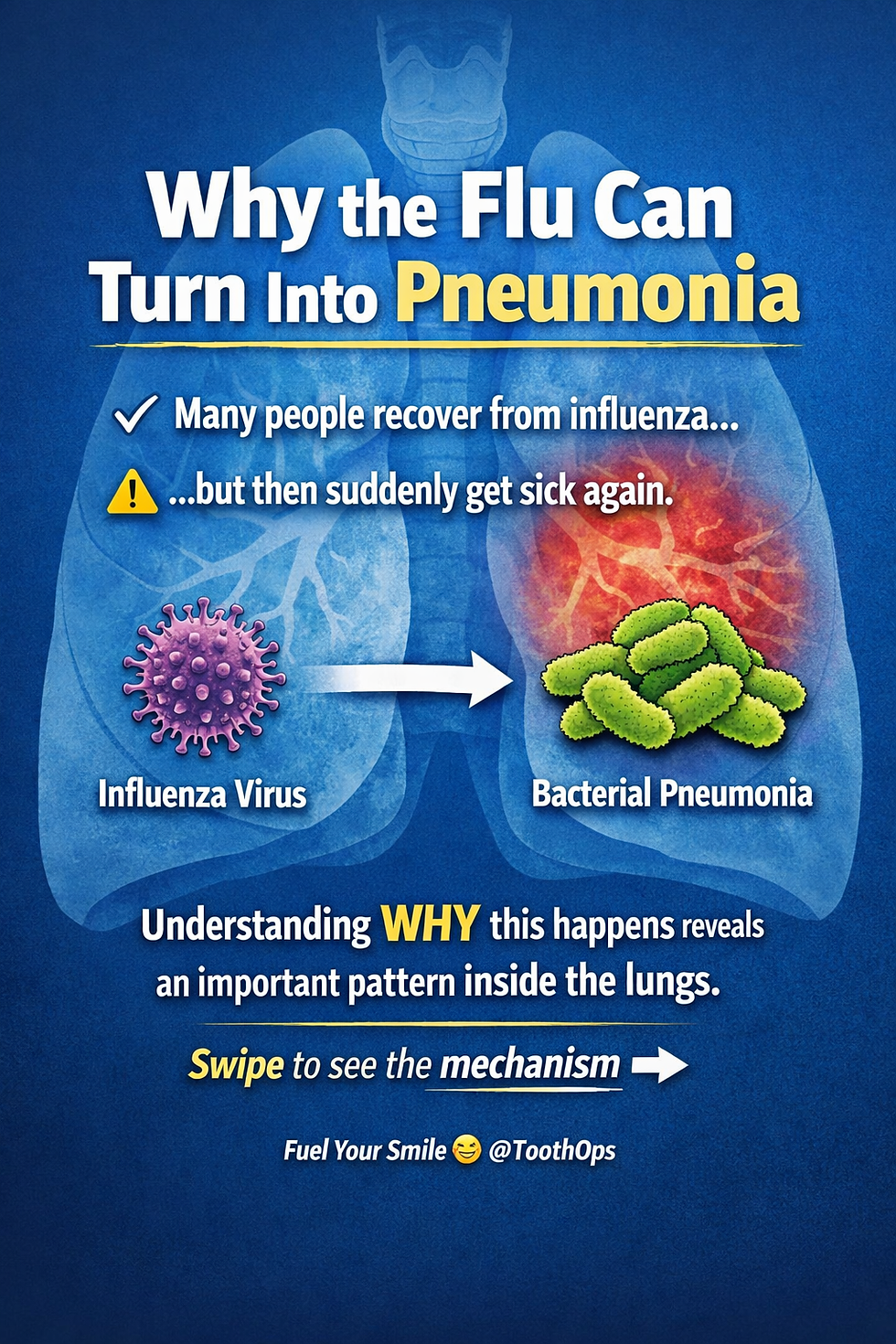
Each year, influenza causes millions of respiratory infections worldwide. Most cases resolve with rest and supportive care. However, clinicians frequently observe an important pattern:
🧠 Patients recovering from influenza sometimes develop bacterial pneumonia several days later.
This progression is not random. It reflects a predictable biological sequence involving the respiratory tract’s defense systems.
Understanding this mechanism helps explain why some viral infections remain mild while others lead to more serious complications.
🩺Start With One Question
Why would a viral infection make someone more vulnerable to a bacterial infection?
To answer this, we need to look at how the respiratory system normally protects itself.
The lungs are exposed to thousands of microorganisms every day through the air we breathe.
Despite this exposure, the lower respiratory tract usually remains sterile because of several built-in defense mechanisms.
🫁 The Lung’s First Line of Defense
The respiratory tract relies heavily on a system known as the mucociliary escalator.
The airway lining contains microscopic hair-like structures called cilia. These cilia beat rhythmically to move mucus upward toward the throat.
🫁 Mucus traps inhaled microbes and particles
🫁 Cilia transport this mucus away from the lungs
This mechanism functions like a biological conveyor belt, clearing pathogens before they can reach deeper lung structures.
Additional protective mechanisms include:
Defense Mechanism | Function |
Mucociliary clearance | Moves trapped microbes upward toward the throat |
Cough reflex | Expels irritants and pathogens from the airway |
Alveolar macrophages | Immune cells that destroy bacteria in lung tissue |
Secretory IgA antibodies | Neutralize pathogens on mucosal surfaces |

💨Where the Cough Reflex Occurs
The cough reflex is triggered by sensory receptors located throughout the respiratory tract.
These receptors are particularly sensitive in:
the larynx
the trachea
the carina (the point where the trachea divides into the main bronchi)
When these receptors detect irritation from mucus, particles, or pathogens, signals are sent to the brainstem. The brain then coordinates a forceful cough to expel the material from the airway.
This reflex helps prevent microbes from reaching the lungs.
💨What Influenza Does to the Airway
Influenza viruses infect respiratory epithelial cells, especially those that contain cilia.
During infection:
⚠️ ciliated epithelial cells become damaged
⚠️ mucociliary clearance slows or stops
⚠️ airway defenses weaken
Once the mucociliary barrier is disrupted, bacteria that normally live in the upper respiratory tract can move deeper into the lungs.
These bacteria may reach the alveoli, the microscopic air sacs responsible for gas exchange.
The Bacteria That Take Advantage
One of the most common pathogens responsible for post-influenza pneumonia is:
🦠 Streptococcus pneumoniae
This bacterium has a major virulence factor: a polysaccharide capsule.
The capsule helps the organism evade immune cells by preventing phagocytosis.
Feature | Clinical Importance |
Gram stain | Gram-positive diplococcus |
Virulence factor | Polysaccharide capsule |
Immune evasion | Capsule prevents phagocytosis |
Transmission | Respiratory droplets or aspiration |
Once bacteria reach the alveoli, they multiply and trigger inflammation.
The alveoli begin filling with:
inflammatory fluid
immune cells
bacterial debris
At this stage, the main problem becomes impaired oxygen exchange.
Gas diffusion across inflamed lung tissue becomes inefficient, producing symptoms such as:
fever
productive cough
fatigue
shortness of breath

Recognizing Secondary Bacterial Pneumonia
Clinicians often identify secondary pneumonia using a characteristic sequence:
1️⃣ Initial influenza infection
2️⃣ Symptoms begin improving
3️⃣ Fever and cough suddenly worsen again
This pattern strongly suggests secondary bacterial pneumonia, a known complication of influenza.
Recognizing this timeline helps clinicians intervene early and begin appropriate treatment.

Where Oral Health Fits In
The mouth contains a complex microbial ecosystem composed of hundreds of bacterial species.
When oral hygiene declines, bacteria accumulate in dental plaque, a structured biofilm that forms on tooth surfaces.
Under certain conditions, bacteria from dental plaque may be aspirated into the respiratory tract.
For medically vulnerable individuals, dental plaque can become a reservoir for respiratory pathogens.
This is why oral hygiene protocols are increasingly emphasized in:
hospitals
nursing homes
intensive care units
Reducing plaque helps reduce the bacterial load that may potentially reach the lungs.
Practical Prevention Strategies
Several simple practices can reduce the risk of respiratory complications.
🪥 Maintain consistent oral hygieneBrushing and flossing reduce bacterial plaque accumulation.
💉 Influenza vaccinationAnnual vaccination reduces the risk of severe influenza infection.
🧼 Hand hygieneRespiratory viruses spread easily through contaminated surfaces.
💧 Adequate hydration and restSupporting immune function helps the body recover from infection.
These habits support both oral health and respiratory health.
📚 Exam Insight
Respiratory infections frequently appear in medical and dental examinations because they integrate microbiology, physiology, and clinical reasoning.
Key Viral Comparisons
Virus | Virus Family | Genome Type | Typical Infection Site |
Influenza virus | Orthomyxoviridae | Segmented negative-sense RNA | Upper and lower respiratory tract |
Rhinovirus (common cold) | Picornaviridae | Positive-sense RNA | Upper respiratory tract |
Important Influenza Viral Proteins
Viral Protein | Function |
Hemagglutinin (HA) | Viral attachment to sialic acid receptors |
Neuraminidase (NA) | Cleaves sialic acid to release new viral particles |
Key Bacterial Pathogen
Pathogen | Key Virulence Factor |
Streptococcus pneumoniae | Polysaccharide capsule preventing phagocytosis |
🧠 Clinical memory anchor
Influenza → epithelial damage → impaired mucociliary clearance → bacterial invasion → pneumonia.
Understanding this sequence connects microbiology, physiology, and clinical presentation.
The Bigger Picture
Respiratory infections highlight how closely different systems of the body are connected.
The lungs, immune system, and oral microbiome influence one another in ways that are not always obvious.
Maintaining good oral hygiene may seem like a small daily task, but it contributes to a broader system of defenses that help protect the body from infection.
Small habits — brushing, flossing, vaccination, and preventive care — support the biological systems that keep us healthy.
@ToothOps | Fuel Your Smile 😊
Understanding the science behind common illnesses allows us to make better decisions about prevention and health.
Stay tuned for more insights and educational content in our blog.
Disclaimer: Content is for educational purposes only and not a substitute for medical or dental care.
© 2025 ToothOps | All Rights Reserved.


Comments