🧬 The Hidden Defenders: IgA, IgE & IgD — The Underrated Antibodies That Protect Your Smile
- ToothOps

- Nov 27, 2025
- 4 min read
1️⃣ Meet the Specialists of Your Immune Squad
When most people think of “antibodies,” they picture IgG or IgM — the textbook superstars.But what about the quiet ones behind the scenes — IgA, IgE, and IgD?
They’re like the special forces of your immune system.Each one has a distinct mission:
IgA stands guard at your mouth’s borders.
IgE sounds the alarm when danger strikes.
IgD stays deep inside the command center, deciding which battles to fight.
And yes — they all matter for your oral health more than you might think.
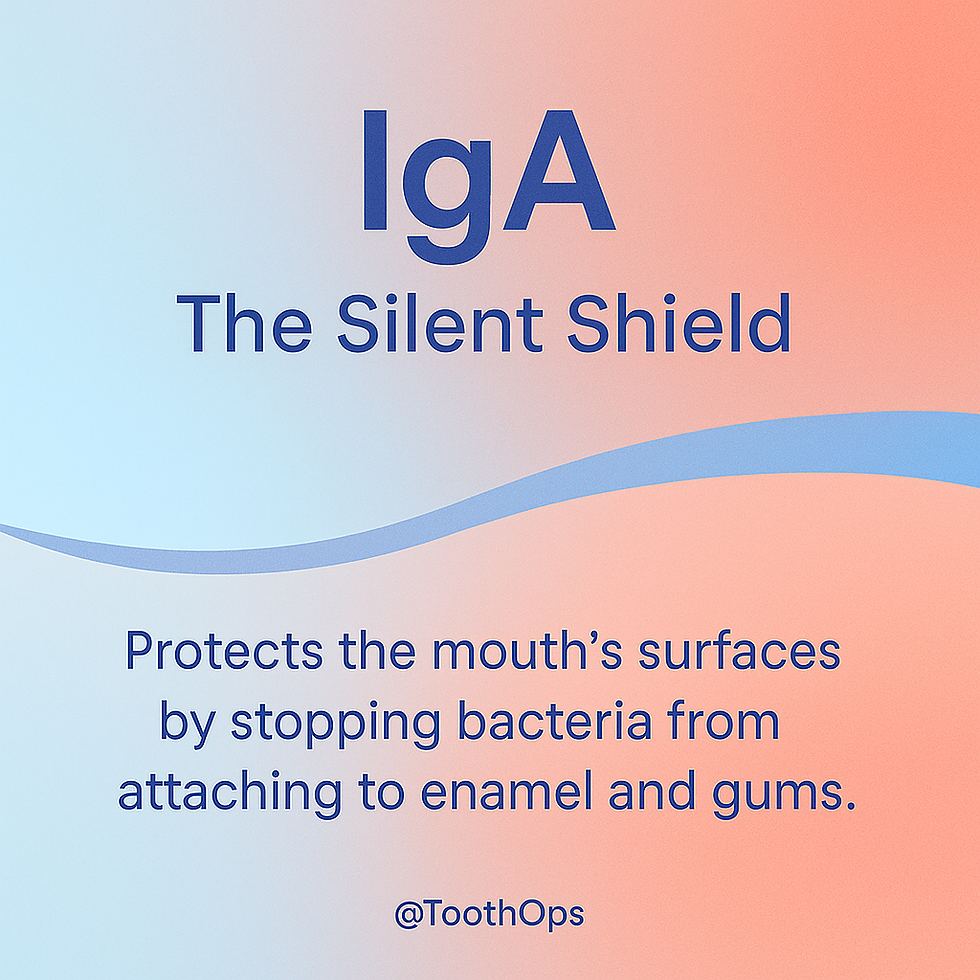
2️⃣ IgA — Your Mucosal Shield 🦷
If your mouth were a castle, secretory IgA (sIgA) would be the drawbridge guard — blocking invaders before they ever cross.
What it does: IgA coats your saliva, tears, and mucosal surfaces, preventing bacteria and viruses from attaching to epithelial cells. According to the Annual Review of Microbiology (2024), sIgA “aggregates microbes, neutralizes toxins, and maintains immune balance at mucosal interfaces.”
Structure & Function:
Exists as a dimer joined by a J-chain and a secretory component — this allows it to survive harsh environments like saliva.
Found in gingival crevicular fluid, saliva, and nasal secretions.
Blocks microbial adhesion and supports a non-inflammatory immune defense (tolerance).
🧠 Analogy Box:
IgA is your mouth’s non-violent peacekeeper — stopping trouble before it starts, without starting a war.
💡 Dental Relevance:Low IgA = higher risk for caries, mucosal infections, and periodontitis.In clinical cases (like the one you studied in your PBL), reduced serum IgA indicates weakened mucosal immunity, making the patient more prone to oral microbial invasion.
3️⃣ IgE — The Allergy Alarm 🚨
Now meet IgE, the body’s hypersensitivity hero — small in number, loud in response.
Function:IgE binds to mast cells and basophils via Fcε receptors. When it encounters allergens or parasitic antigens, it triggers degranulation — releasing histamine, prostaglandins, and leukotrienes.According to StatPearls (2025), “IgE is the least abundant immunoglobulin but plays a critical role in type I hypersensitivity and defense against helminths.”
🧠 Analogy Box:
Think of IgE as your immune system’s fire alarm: quiet until smoke (allergen) appears, then blaring with inflammation.
💡 Dental Relevance:
Patients with high IgE may have exaggerated responses to allergens — even dental materials or anesthetics.
IgE-mediated mast-cell activity can amplify gingival swelling and vascular permeability, mimicking periodontal inflammation.
Always ask patients about allergy history — understanding IgE helps differentiate allergic edema from infectious inflammation.

4️⃣ IgD — The Immune Radar 📡
IgD is the most mysterious of the group — quietly shaping the immune landscape.
What It Does:
Expressed on the surface of naïve B cells alongside IgM as part of the B-cell receptor (BCR) complex.
Functions as a sensor that helps B cells recognize antigens and initiate adaptive immunity.
Secreted IgD (in very small amounts) binds to basophils and activates antimicrobial peptide release.
Research in Frontiers in Immunology (2021) suggests that IgD “acts as a molecular switch controlling B-cell activation and tolerance.”
🧠 Analogy Box:
IgD is your immune system’s radar dish — scanning for threats and guiding other antibodies to respond appropriately.
💡 Dental Relevance:In oral tissues, naïve B cells expressing IgD may help regulate gingival immune responses. Disruption in IgD-mediated signaling could alter local immune tolerance, possibly contributing to exaggerated inflammation or autoimmunity in periodontal diseases.

5️⃣ Putting It Together — Antibody Table for Dental Recall
Antibody | Main Site | Function | Dental Relevance |
IgA | Saliva, GCF, mucosa | Neutralizes microbes; blocks adhesion | Low levels = ↑ risk of oral infections & caries |
IgE | Bound to mast cells/basophils | Allergic & parasite defense | High IgE = risk of hypersensitivity to dental materials |
IgD | Naïve B cell surface | BCR signaling; immune regulation | Regulates gingival immune tolerance & B-cell activation |
6️⃣ Case Reflection — When IgA Is Down
In your patient’s case, serum IgA was markedly reduced, while IgG and IgM were normal.This suggests selective IgA deficiency, the most common primary immunodeficiency in humans.
🧬 Mechanistic Link:
Reduced sIgA → decreased mucosal barrier protection.
Increased exposure to pathogens like Porphyromonas gingivalis → inflammation and bone loss.
Explains why even with antibiotics (amoxicillin, metronidazole), long-term management requires host-modulation and plaque control, not just medication.
🧠 Clinical Insight:
Without IgA, oral tissues lose their “first line of defense.” It’s like leaving your front door open during flu season.
7️⃣ Exam-Ready Quick Facts
Topic | Key Point |
IgA Structure | Dimer with J-chain + secretory component |
IgE Trigger | Type I hypersensitivity → histamine release |
IgD Role | B-cell receptor for antigen recognition |
Dental Focus | Mucosal defense, allergy management, immune regulation |
Mnemonic | A = Armor, E = Emergency alarm, D = Detector |
8️⃣ Real-World Takeaway 🩺
You’ll rarely see “IgA” on a patient’s chart — but understanding it will make you a sharper clinician.Immunology isn’t abstract; it explains why some patients heal faster, others relapse, and why oral health is more than plaque and pockets.
🦷 Remember:Every antibody is a story of adaptation. As a dentist-in-training, you’re not just cleaning teeth — you’re restoring balance to the body’s most exposed immune frontier: the mouth.

✨ Final Thought
Immunology is complex, but mastery starts with curiosity.Next time you look at a swollen gingiva or stubborn infection, think: “Is this about bacteria — or about the body’s missing defenders?”
That’s when you start thinking like a clinician, not just a student.
@ToothOps | Fuel Your Smile 😊
Stay tuned for more insights and educational content in our blog.Disclaimer: Content is for educational purposes only and not a substitute for medical or dental care.© 2025 ToothOps | All Rights Reserved


Comments