🪥 Deep Clean, Deep Healing: What Scaling and Root Planing Really Does Beneath Your Gums
- ToothOps

- Nov 20, 2025
- 5 min read
If you could shrink down smaller than a red blood cell and travel under your gums, you’d see a war zone — biofilm bunkers, mineral crusts, and tiny immune soldiers caught in crossfire.
That’s where scaling and root planing (SRP) steps in. It’s not “just a deep cleaning.” It’s the rescue mission your toothbrush can’t lead.

1️⃣ Under the Gumline: Where the Battle Begins
Picture the space between your tooth and gum as a narrow canyon. In health, it’s a snug 1–3 mm — shallow enough that brushing and flossing keep it clean.
But when plaque lingers, bacteria colonize the canyon walls, forming a sticky biofilm fortress.
As minerals from saliva harden it, calculus builds like concrete. Oxygen levels drop, and anaerobic pathogens move in.
The body fights back with inflammation — red, swollen gums, bleeding, and gradually, bone loss. By the time pockets reach 5 mm or more, toothbrush bristles can’t reach the enemy lines.
🧠 SRP is like sending a trained dive team under a pier to scrape away barnacles before the wood rots.
2️⃣ What Actually Happens During SRP
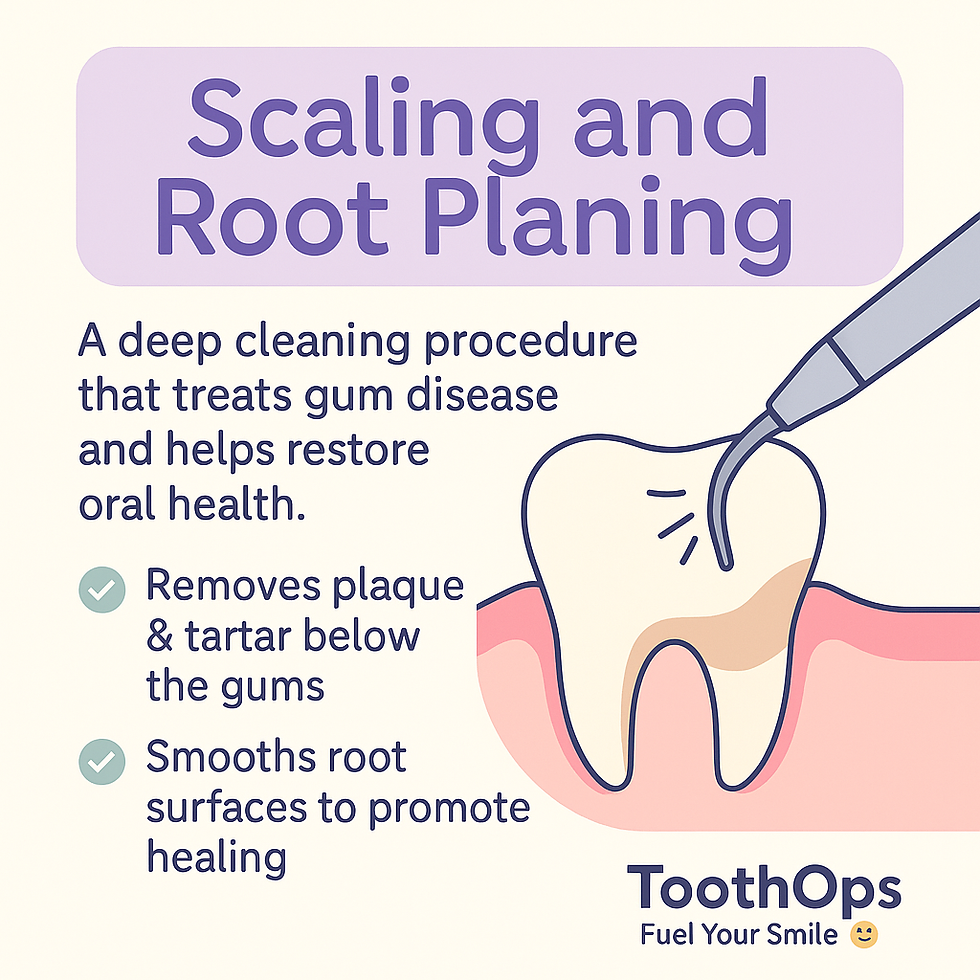
Your hygienist becomes that diver. Using fine ultrasonic tips and hand scalers, they navigate beneath the gumline — sometimes 6, 8, even 10 mm deep.
Scaling removes the bacterial calculus deposits. Root planing smooths the root’s surface so the gum can re-attach and seal the pocket.
Each stroke breaks apart biofilm colonies whose toxins — endotoxins and lipopolysaccharides — had been poisoning surrounding tissue (Carranza, 2023).
Local anesthesia keeps it comfortable, but make no mistake: this is precision microsurgery without a scalpel.
🧠 Imagine polishing the hull of a ship so clean that barnacles can’t cling again — that’s what root planing does for your teeth.
3️⃣ The Microscopic Aftermath: Healing in Motion
Within minutes, inflammation starts to retreat.Capillaries reopen; oxygen returns. Fibroblasts migrate to the cleaned surface, laying new collagen fibers.
By day 3, epithelial cells begin re-attaching to the root.By week 2–3, the pocket lining is replaced with a tight epithelial seal.By 6 weeks, re-evaluation shows shallower pockets, firmer gums, and reduced bleeding (Gehrig, 2020).
🧠 It’s like reseeding grass after removing weeds — the healthy tissue finally gets sunlight and space to grow.
4️⃣ Why It’s Called “Deep”
SRP goes where routine prophylaxis stops. A regular cleaning polishes crowns; SRP restores the foundation.
Each quadrant of the mouth often gets treated separately to allow precision and proper anesthesia. If ignored, untreated pockets become chronic infection reservoirs, feeding systemic inflammation linked to heart disease and diabetes (ADA, 2024).
💡 Pro Tip:If your dentist recommends SRP, it means they found pockets beyond 4 mm — not a scare tactic, but a blueprint for saving bone.
5️⃣ The Feeling After: Tender Yet Transforming
Right after SRP, patients often say, “My teeth feel longer!” — that’s not imagination. The swollen gum tissue that once covered the crown shrinks back to a healthy contour.
Mild soreness or cold sensitivity for a few days is common. Warm salt rinses, soft brushing, and desensitizing toothpaste help.
Within weeks, breath freshens, gums regain their coral-pink color, and you notice the “tight hug” returning around each tooth.
🧠 Think of it like taking off tight shoes after a long hike — your gums finally breathe again.

6️⃣ When Scaling Meets Science: Why It Works
SRP succeeds because it resets three key systems:
Microbial Balance — Disrupts pathogenic biofilm, allowing beneficial bacteria to recolonize.
Tissue Regeneration — Removes endotoxin barriers so fibroblasts can rebuild attachment fibers.
Host Response Reset — Lowers inflammatory cytokines, reducing systemic immune stress.
Research shows SRP can reduce probing depths by 1–2 mm and gain attachment by up to 1 mm in moderate cases (Carranza, 2023).
That might sound small, but in gum architecture, 1 mm can mean the difference between keeping and losing a tooth.
7️⃣ Beyond the Scaler: Adjuncts That Boost Healing
SRP is the core, but modern dentistry often pairs it with targeted reinforcements:
Locally delivered antimicrobials (Doxycycline gel, minocycline microspheres) to suppress residual pathogens.
Systemic antibiotics in aggressive or systemic cases.
Laser assisted decontamination to sterilize pockets.
Probiotic rinses to rebalance flora.
🧠 Think of SRP as clearing the battlefield; these adjuncts are reinforcements that secure the peace.
8️⃣ Maintenance: The Unsung Phase of Healing
SRP is only successful if followed by periodontal maintenance every 3–4 months.Why?
Because the bacterial biofilm begins reorganizing within 90 days.
Each recall visit removes new deposits before they harden into calculus. It’s ongoing defense — not punishment, but protection.
Patients who maintain this schedule keep periodontal health stable for decades (Gehrig, 2020).
💡 Pro Tip:Think of maintenance as Netflix’s “continue watching” feature — skip too long, and you lose your place in healing’s storyline.

9️⃣ Behavioral Reboot: Your Daily Role
SRP can’t fight alone. Healing depends on what happens every morning at your sink.
Your at-home toolkit:
Soft-bristled or powered toothbrush angled 45° toward gumline.
Interdental brushes for open spaces.
Daily floss (or water flosser for tight contacts).
Antimicrobial rinses after brushing.
Balanced diet with vitamin C and omega-3s to support collagen repair.
And, of course, no smoking — nicotine halves healing capacity (CDC, 2023).
🧠SRP is the professional cleaning crew; home care is keeping the party under control after they leave.
🔟 The Mindset Shift: From Fear to Empowerment
Many people hear “deep cleaning” and imagine pain, drills, or judgment.But the truth? SRP is one of the most rewarding dental procedures — it doesn’t just stop disease; it visibly transforms tissue.
Within weeks, patients often say:
“My gums don’t bleed anymore.”“Food doesn’t get stuck like before.”“I didn’t realize how bad my breath was until it was gone.”
Each statement is biology’s thank-you note for removing chronic infection.
🧠 SRP isn’t punishment for neglect — it’s a restart button for your mouth’s ecosystem.

🩵 Final Takeaway
Under every smile is a foundation — bone, ligament, and soft tissue — working tirelessly to hold it all together.Scaling and root planing aren’t just about scraping teeth; they’re about reclaiming that foundation.
When you say yes to a deep cleaning, you’re saying yes to:
Healthy oxygen flow
Balanced bacteria
Restored collagen fibers
A future where your smile doesn’t collapse with time
So next time you hear your hygienist say, “We’ll do a deep cleaning,” picture it not as drilling or scraping — but as a microscopic rescue mission that saves your smile’s blueprint.
“Healing begins where fear ends — under the gumline, where quiet work rebuilds confidence one pocket at a time.”
@ToothOps | Fuel Your Smile 😊Stay tuned for more insights and educational content in our blog.
Disclaimer: Content is for educational purposes only and not a substitute for medical or dental care.
© 2025 ToothOps | All Rights Reserved


Comments